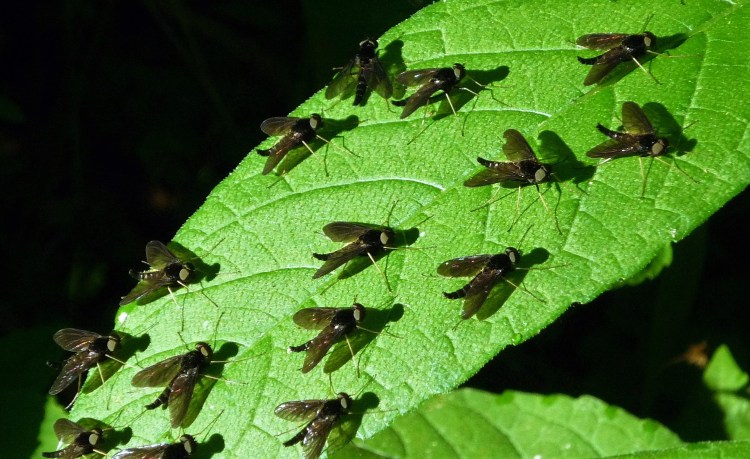
These Snipe Flies, genus Chrysopilus, emerged in great numbers over the past couple weeks
If there ever was an under-appreciated life form, it would have to be the insect. You may not be feeling very appreciative as you scratch your latest mosquito or chigger bite, but you can be sure that some creature is.
I’ve had some input from readers lately that encouraged me to make helpful changes. It’s now easy to comment and “like” the posts – my settings were making this difficult. Also, in your email reader there will be a “keep on reading” message after the first little bit, that will direct you to the blog website – which is a lot better looking! This also allows me to keep track of views.
The newest post is “Why We Do What We Do”
Happy reading and see you in the forest!
Cave Salamander hunting insects at night on the LNC front porch
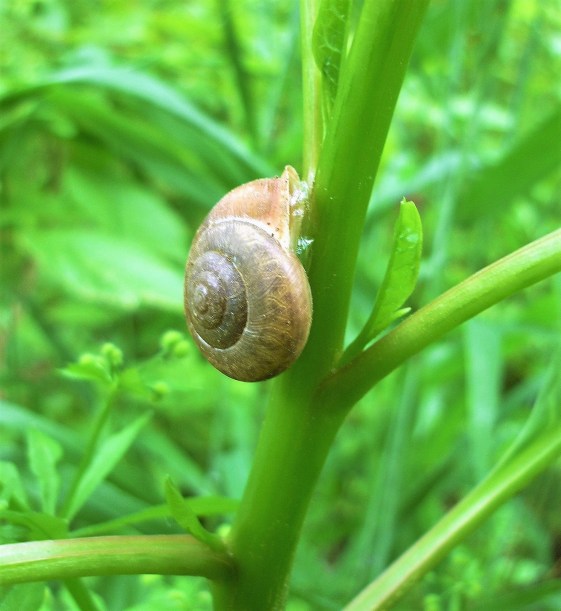
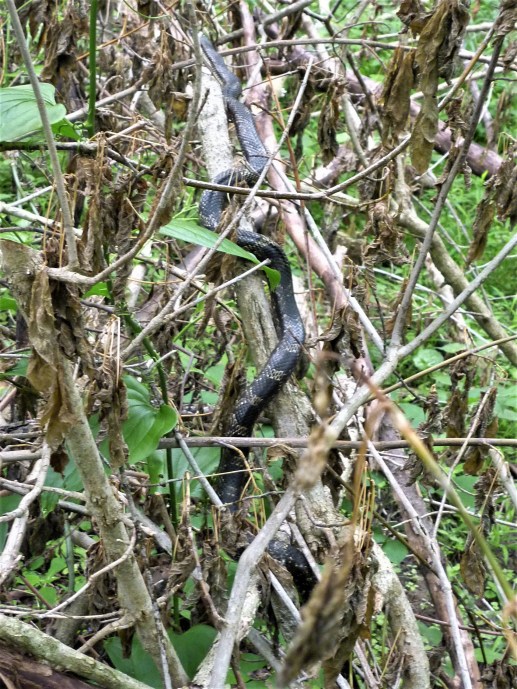
A diversity of tender herbaceous plants provides food for snailsBetter wetland habitat means more dragonflies – walk in our forest on a hot sunny day to see a variety of speciesOne animal that really enjoys our brush piles – the high-climbing Black Rat Snake, Pantheropsis obsoletus
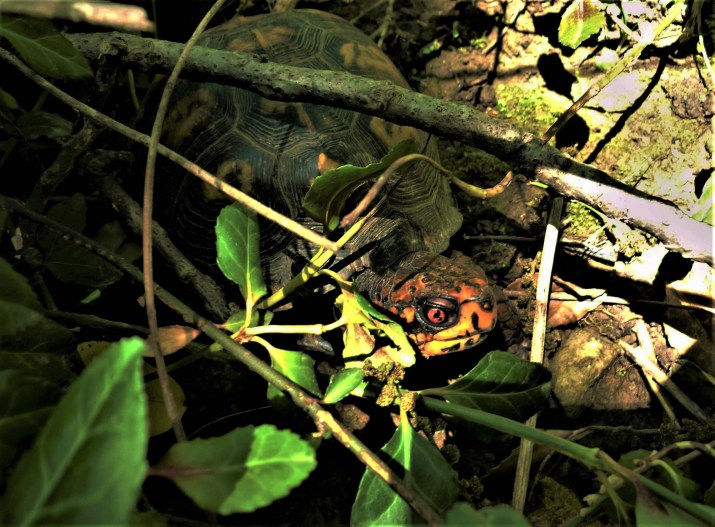
Why do plants and animals live the life spans they do? When I’m old in human years, I’m still young next to the massive Pin Oak in my backyard. But most of the animal species in our forest will enjoy a much shorter lifespan than me, except for one – the Eastern Box Turtle. As with other members of its turtle clan, a slow metabolism and heavily armored carapace mean there’s a good chance at a long life. Box Turtles don’t even mature sexually till between five and ten years of age, but can still reproduce into their fifties and beyond.
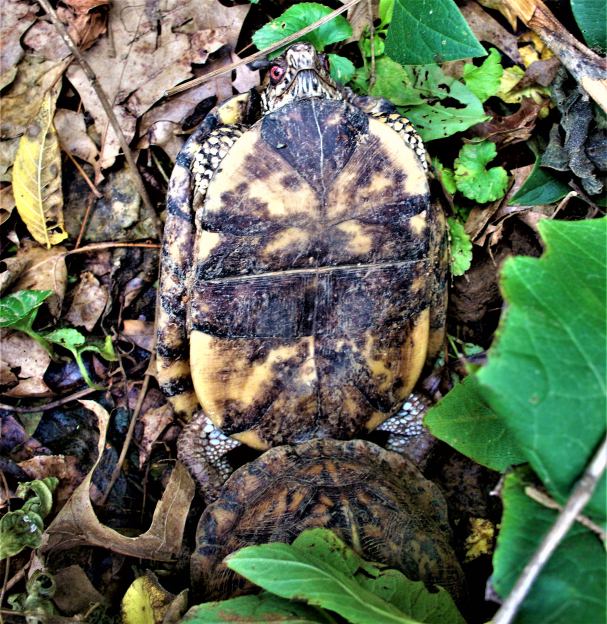
The downside of mating – falling over on your back and being stuck there for awhile
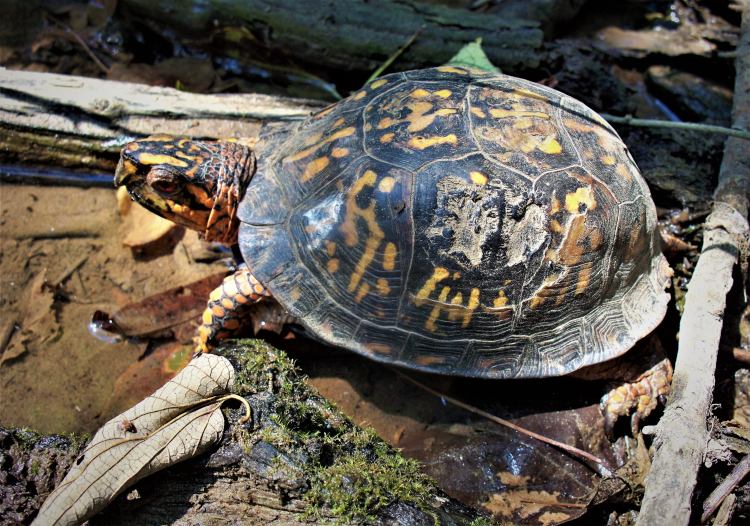
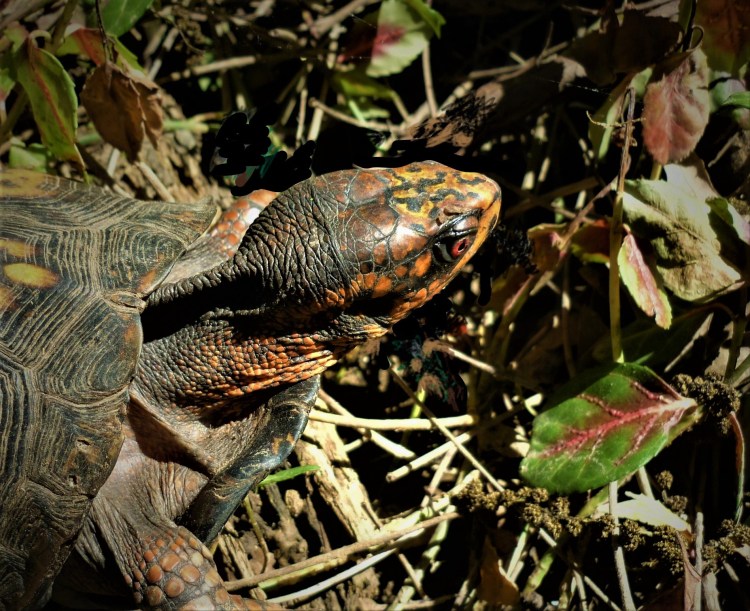
But how did we figure out just how long they can live? One of the problems with estimating the age of a Box Turtle is that they all look old. The female in the pic below is relatively young, (20 to 30 years) based on the number and condition of the scute (scale) lines on her carapace. But to look at her wrinkly scaly skin, we might assume she is quite aged.
One of the first clues to Box Turtle longevity was the outdated (hopefully) custom of carving one’s initials along with the date, into box turtle plastrons. These little grabs at posterity can be quite useful to scientists, as in the pic below. This turtle was observed in Rhode Island in 1955 (still healthy and active), with the well worn dates of 1844 and 1860 still visible on its underside. Since the practice of carving on boxies was relatively common back in the day, researchers think the dates are likely authentic – meaning this turtle and many others topped the 100 year mark!
But lacking any convenient carvings, how do we determine the age of any random turtle we meet? Young ones are easy; the scute lines are prominent, unworn, and relate somewhat to the age of the turtle (though not exactly). Their scute patterns are still basic, not having grown into the beautifully unique complexity of mature boxies. And they’re still little; turtles continue to grow till reaching mature size about the age of twenty. However, most of the oldest turtles I have observed were larger and heavier than the usual adult.
It’s a good guess this one is less than ten years old
Most wild Boxies we see are in the young adult to middle aged range, from about 15 to 40 years old. If a turtle can survive this long it has a good chance of getting much older. The main threats it could encounter – disease, mowers, cars, human collectors, habitat destruction.
A typical brightly patterned adult with unworn scutes and a clearly visible pattern
A middle aged turtle can have significant healed damage to its carapace, as does the lucky fellow in the pic below.
But it’s not the same as the carapace of a truly old turtle. Though I’ve met ones that looked much older than usual, I had no support for my opinion until I came across this:
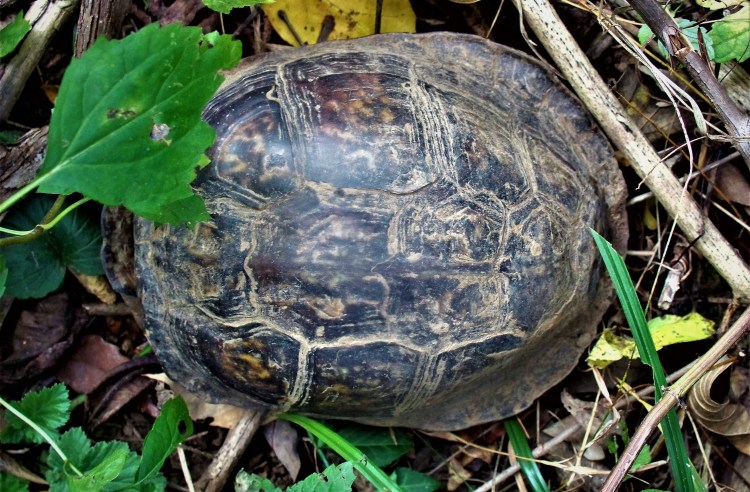
Quoting from a study by Lucille Stickell, a famous early researcher of Box turtles – “As turtles become older, the clear-cut ridges of the growth lines gradually smooth. Eventually the outer layer of horn peels off, exposing a second layer closely adherent to the bone; the carapace is then so smooth that it is not feasible to count growth lines.”
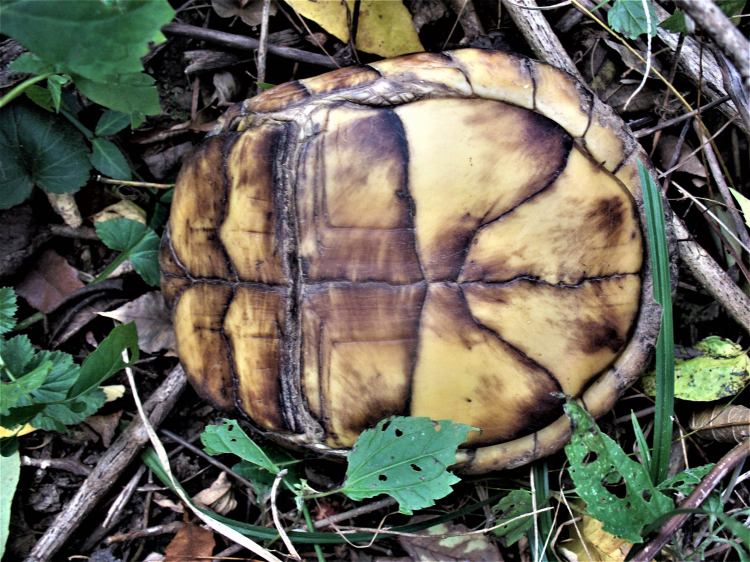
Considering this, here are pics of two turtles living in our forest that are likely quite old. How old? Since a Box Turtle’s typical lifespan is about 50 years, I will go out on a limb and say these two are likely 60, 70, 80 years plus. The only way to be absolutely sure is to follow a young turtle over many decades, that was marked as part of a research study. There are boxies over 80 that have been fully documented this way.
Note the blurred pattern and degree of wear on this oldster’s carapace
The flat plastron with no concavity shows it’s a female
This old male has similar scute characteristics as the female above; both have very scalloped edges on the rear of the carapace
His plastron shows much wear, as well as a mystery hole
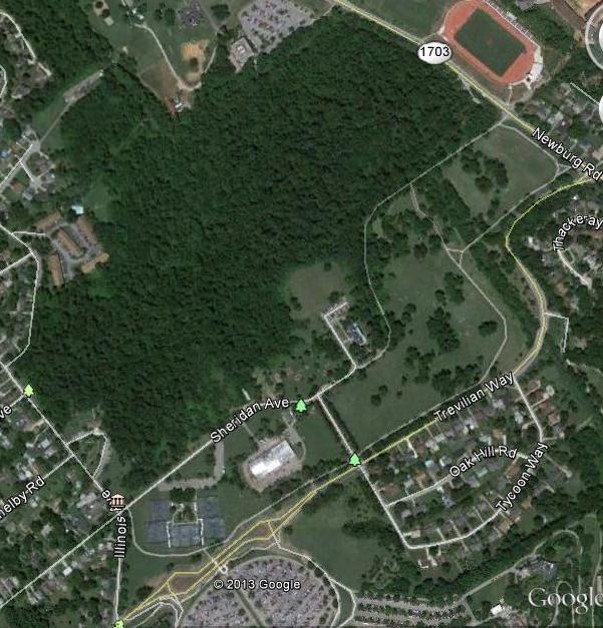
If these turtles are 80 years or older, they lived in a very different sort of forest as youngsters. The pic below shows our forest fragment when it was even more of a fragment. In the 1930’s the swampy bottomland portion had been ditched and drained, and was being used for crops. The bits of pasture and woodland were grazed by livestock, and most of the trees were young.
Historic aerial from 1930’s
Contrast this with a pic taken recently; forest has recovered most of the former clearings.
But a fragment of forest here and there, however nice the habitat, is still just a fragment. And female Box Turtles in particular, may need to venture outside of these fragments to find sunnier spots for nesting, placing them at risk.
Along with the capacity for longevity, boxies have a very slow rate of reproduction. The only way mating happens is if a male and female see each other – no mating calls or pheromone scents. A female may store sperm up to four years in case she doesn’t meet another male, and as populations dwindle a meetup is less assured. Though a female may lay many hundreds of eggs in her lifetime, turtle researchers believe only a fraction ever get to hatch, much less live beyond infancy (thanks to abundant populations of raccoons and skunks).
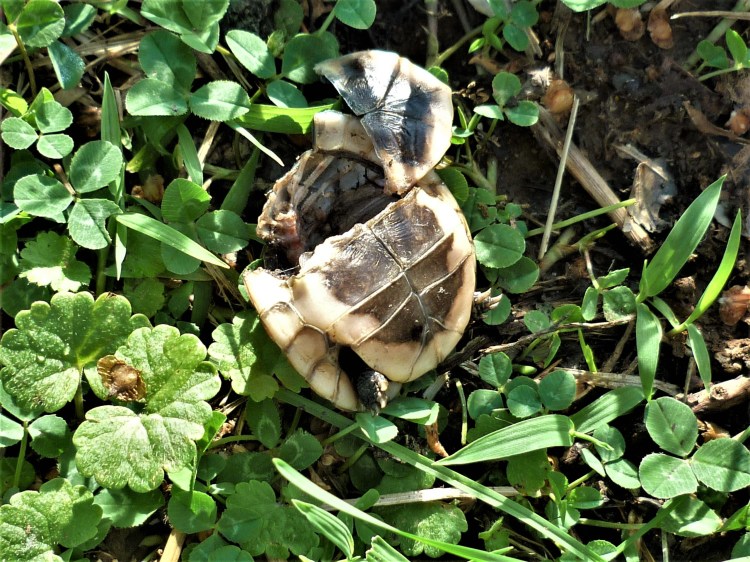
It’s very hard for researchers to even determine how many young boxies are out there, since they’re completely in hiding for their first couple years. The hinge between the carapace and plastron isn’t developed yet, and their shell is still soft, so they’re food for many other animals.
The remains of this tiny Box Turtle were found in the LNC front garden
The next time you encounter a wild boxie, take a closer look. She or he has likely lived their entire life within a small portion of the surrounding area – termed its “home range”. Through a long life it has come to know every feature intimately. There are rotten tree trunks to hibernate under or search for food in, wet places to cool off when it’s hot, bushes and trees with berries. Show some respect, and please don’t move it from this spot – this turtle may be older than you.
Sometimes the week’s adventures don’t offer an obvious theme to neatly tie them all together. Unlike the inhabitants of the meadow in my previous post, these three were seen in various places, and don’t seem to have much in common (other than being in our forest.) But they do share one attribute – they’re all travelers.
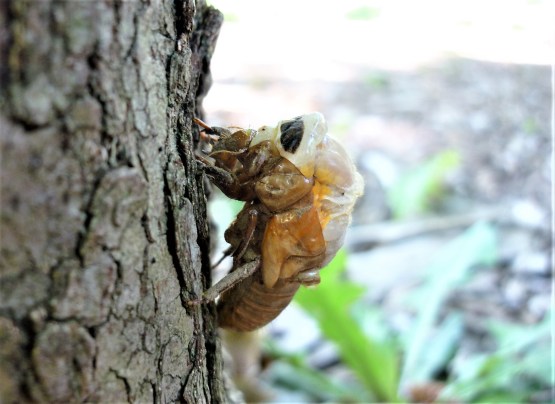
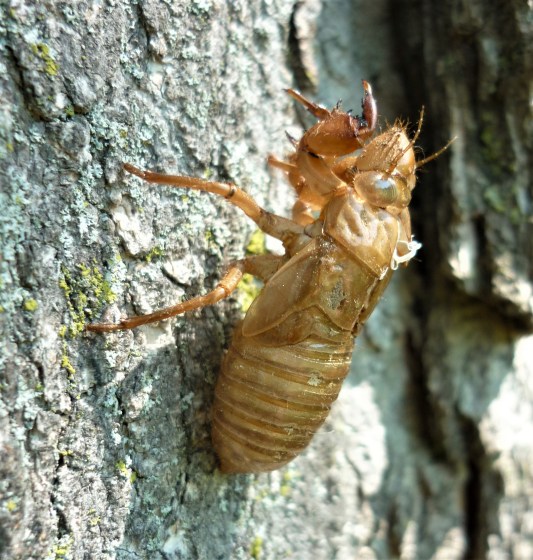
17 yr Cicada, genus Magicicada
This red-eyed beauty is a time traveler, feeding quietly through the long years and resurfacing to a different world, in the same place. We’re now seeing a three-years-early emergence of 17 year Periodical Cicadas, Brood X. You may remember this brood from its last emergence in 2004. Not expected to emerge till 2021, but climate change has tricked them into thinking it’s time. And the birds are happy. A few days ago I watched several Red-bellied Woodpeckers plucking the hapless newly adult cicadas from tree trunks, and even snatching one in mid-air, Phoebe-style.
Their perfectly round emergence holes can be easily spotted under older trees, as can the rather creepy google-eyed dried husks that were their nymphal skins. (It’s a very distinct memory from childhood – my young naturalist’s mind found them creepy and fascinating by turns).Today I heard the grinding of Cicada chorus notes starting up, making it feel like the dog days of summer are here already.
At the base of big trees, it’s easy to observe their emergence and rapid metamorphosis to adults. These older trees have gradually built up a below ground population of larvae that drink sap from the roots.The nymph crawls up a tree trunk if possible, and splits down the back to reveal the soft, pale new adult. The greater the numbers that emerge at one time, the better chance that predators will be so glutted that some are left to mate.
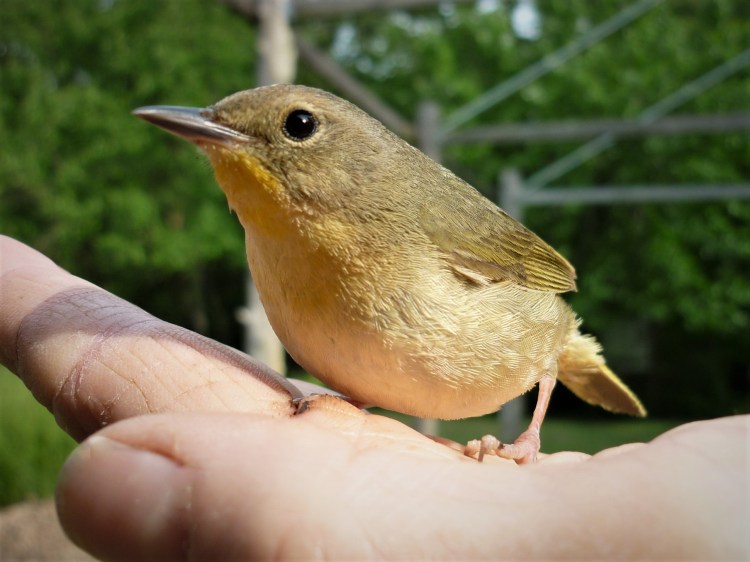
Our next traveler definitely moves through space; as a Neotropical migrant it makes a long and perilous journey every spring and fall. This little female Common Yellowthroat’s travels almost ended for good when she hit the glass windows at the rear of the Louisville Nature Center.
This site is particularly dangerous to small birds – they see only the illusion of forest in the reflective glass, and fly headlong, usually to their deaths. This one was lucky; it must have been a glancing strike. Though dazed at first and clenching its left foot, it perked up within minutes and I released it to continue its morning forage for insects.
note the clenched foot
It’s hard to believe how tiny these neotropical warblers are, until you have one in your hand. Moving seasonally between Central and North America, most of them must embark on a 20 hour non-stop flight of as much as 650 miles, just to cross the Gulf of Mexico. The Common Yellowthroat skulks about in marches and tangled wet meadows, where you may hear the male’s “witchety-witchety-witchety” song.
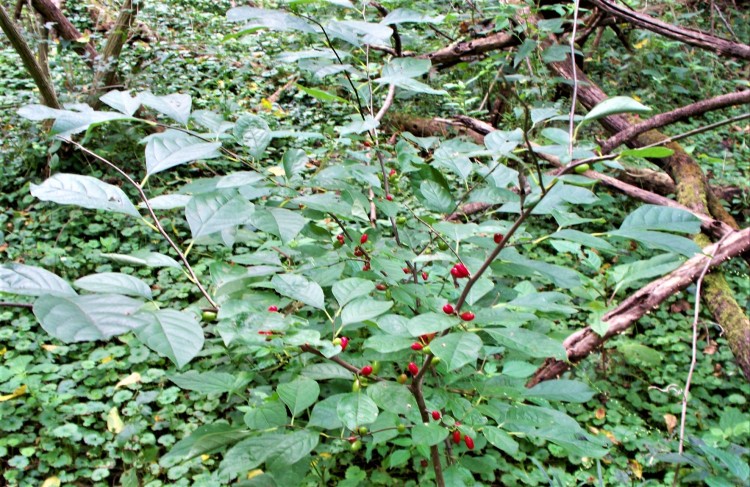
Our last traveler did not get here by itself – it was assisted and welcomed by humans. Asiatic Bittersweet’s long and tangled(!) trajectory from novel horticultural planting to hated invasive is a familiar one. In our forest as elsewhere it’s a strangler; encircling mature trees, or even itself to in order to get to the top of the canopy.
It’s the prime directive of vines – climb to the sunlight to reproduce.
As do most of our worst invasives, it produces a berry reward of such magnitude that no frugivore bird can resist it. Introduced to the east coast in the 1860’s from Japan, the first wild escape of this vine was noted in 1910 – from there the chart of its population trajectory goes straight up.
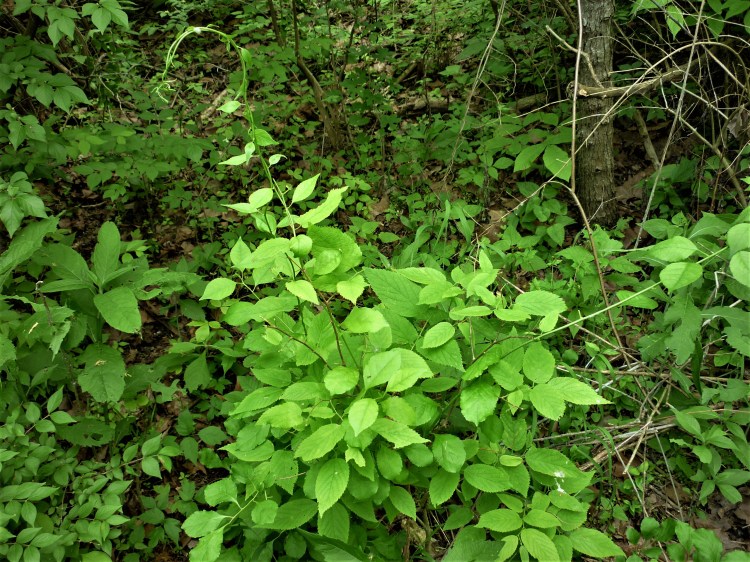
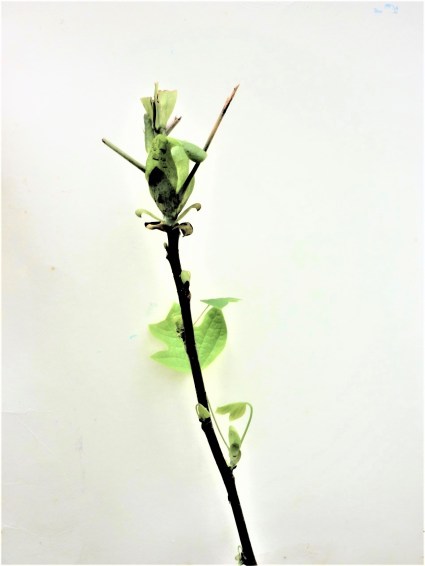
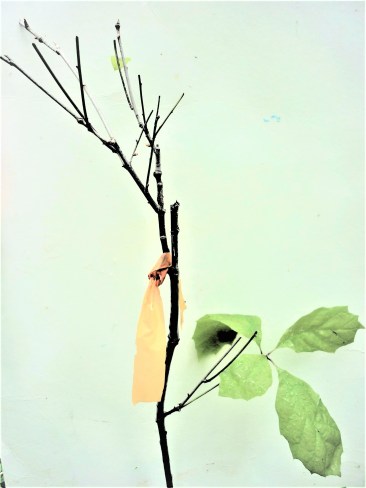
Oriental Bittersweet displays it’s circular twining habit from the very start. In the pic above a young vine is exploring for a support with its fast-growing tip. Unlike vines with tendrils ( grapevine, etc.), bittersweet wraps it’s entire growing stem around an unlucky tree. The process is just starting in the pic below.
In addition to taking over huge stretches of woodland, Oriental bittersweet is eliminating our native bittersweet species in many places through a double strategy of competition and hybridization.
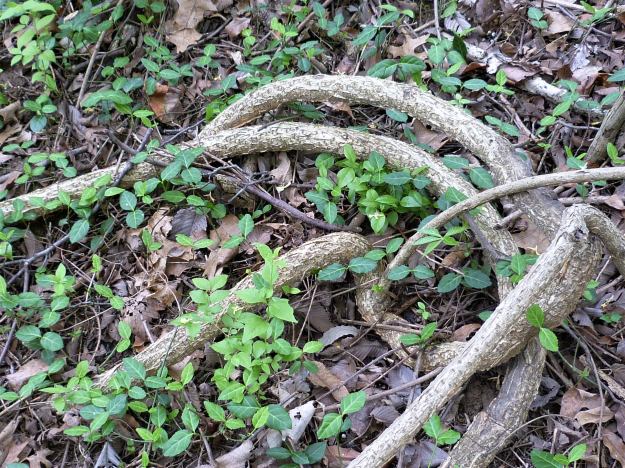
old growth Oriental Bittersweet vines
It’s hard not to admire invasive plants, and even ascribe human characteristics to them. Many well-behaved(?) native plants can go on a rampage in different circumstances. Our more assertive natives such as White Snakeroot and Black Locust are invasive trouble-makers in Asia, so there is some equity.
In closing, one more native species running amok – at least they’re cute!
This snail has likely been feeding on the brown, stinky “gleba” of Mutinus caninus, Dog Stinkhorn. Latin name literally translates as little dog penis.
Early spring is past, and the delicate ephemerals have withered to yellow. The race is on – to be the tallest plant, the first-fledged baby bird, the biggest salamander larva in the stream. Life is busy and competitive, in this little meadow and everywhere in the forest.
We urban dwellers go for a walk in the woods to find relief from our daily grind – but the creatures who live here are not a having a restful time of it. Imagine having to find insects to cram into three or four hungry mouths, all day long. Then feeding and watching over your helpless, newly fledged young, and doing this multiple times every summer of your short life. Would you like to be a bird?
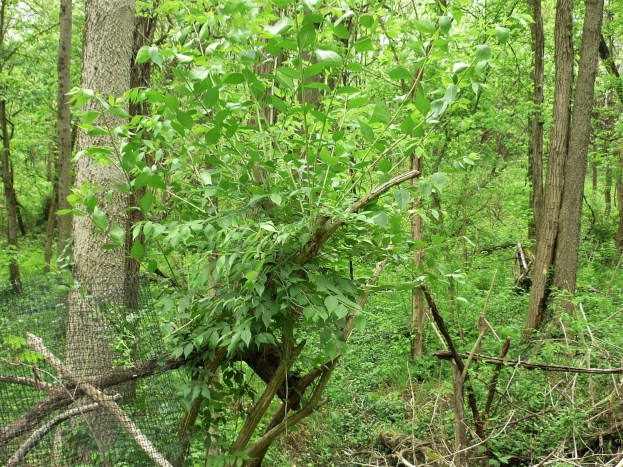
In a corner of the meadow is a Bush Honeysuckle – I’ve cut off its top and let it re-sprout, with plans of cutting it again. As I walked past it last week, a distressed mama cardinal flew out…
These “bushy tops” have become prime real estate for low nesting birds
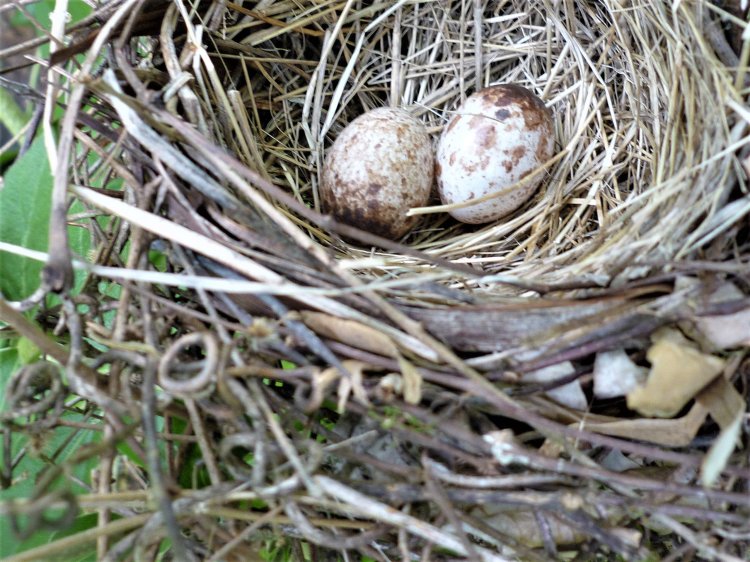
Parting the leaves revealed this sprawling cup. Note the array of nesting materials, especially the grapevine tendrils. Perhaps their curliness allows them to function like little hooks, helping hold it all together.
And finally, two speckled eggs that look like brown paint was dabbed on them. After taking this pic, I left in a hurry, feeling pretty guilted by the parent birds distress calls.
In the same meadow, spotted this leaf-footed bug Acanthocephala terminalis, hanging out on the underside of a Hackberry leaf. The leaf shaped extension on its hind legs explains the name. You can barely make out the distinctive orange tipped antennae.
Our acquaintance from an earlier post, Box Turtle #185, also lives in this meadow by the stream. Last time we saw him he was eating a slug. His home range seems pretty small, perhaps it’s such rich habitat he can find all the food he needs nearby.
Note snail at bottom of pic, he probably ate it later
And closer to the stream, some Jelly Ear fungus, Auriculariaauricula judae (!) emerging from a dead tree. These are becoming most numerous due to all the rain.
need a new ear?
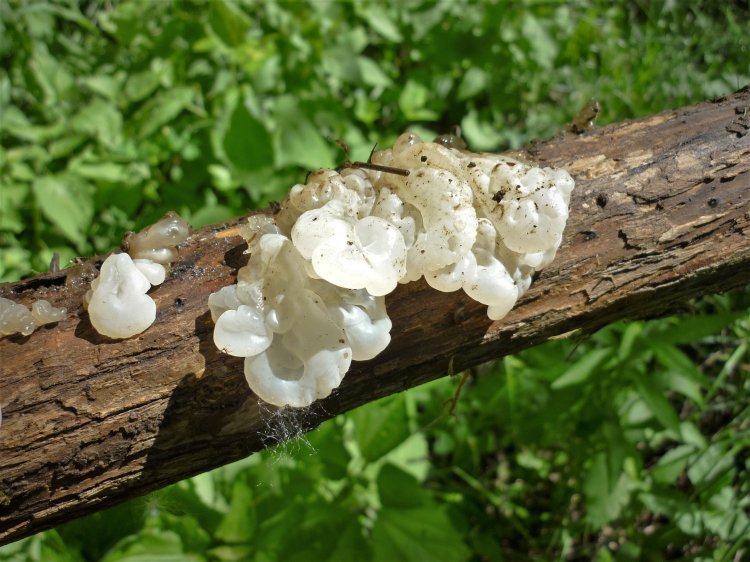
Nearby, a blobby translucent white fungus – my best guess is Sebacina pululahuana, for which there is no common name.
it was growing on the underside of the log, but I held it in sunlight to get a pic
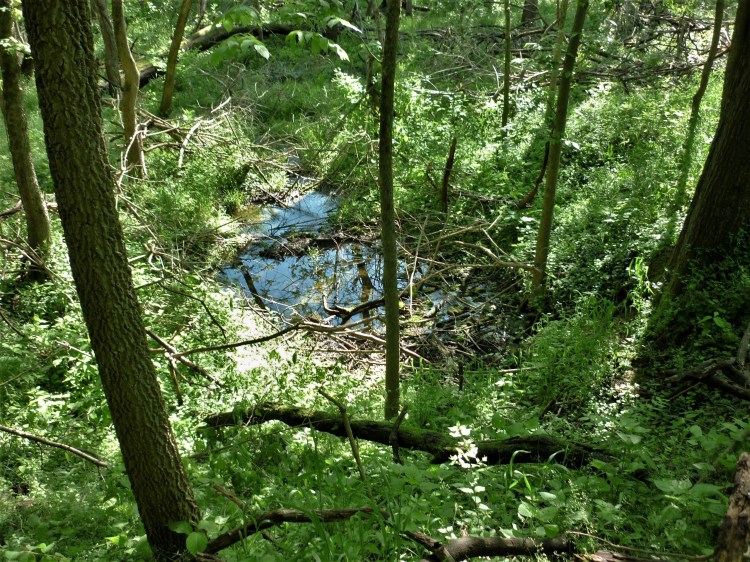
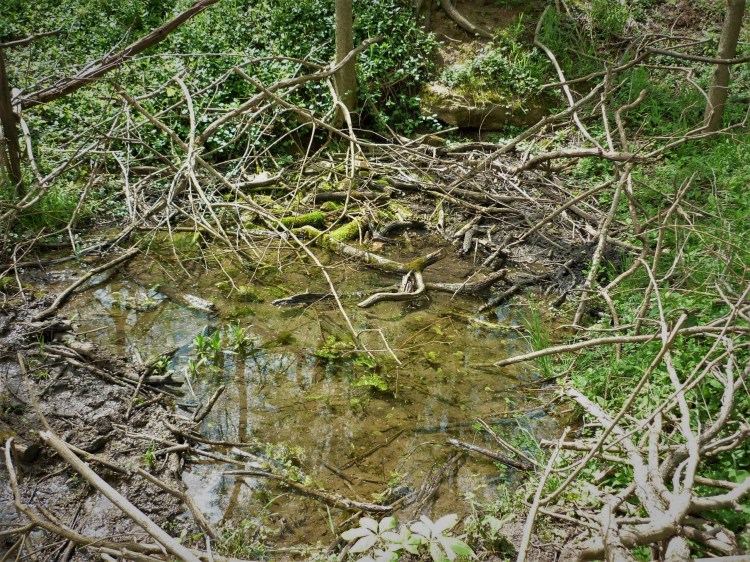
To grow to be the biggest salamander in the stream, you first need a great pool to grow up in. This little sky-reflecting gem is one of my favorite places – below a giant Black Walnut a cold spring trickles from a limestone fissure, filling a series of small pools.
I revived this spring by digging out what had become a foul smelling muck-hole full of rotten black walnuts, then damming up the pools with heavy clay dug out of the bottom.
Cave Salamanders live back in the limestone passageways; their larvae emerge into the pool in spring as tiny dark creatures with gills, barely half an inch long. They grow through the summer, gradually wandering downstream as they get bigger…
…until eventually maturing as beautiful golden eyed, orange with black spots adults.
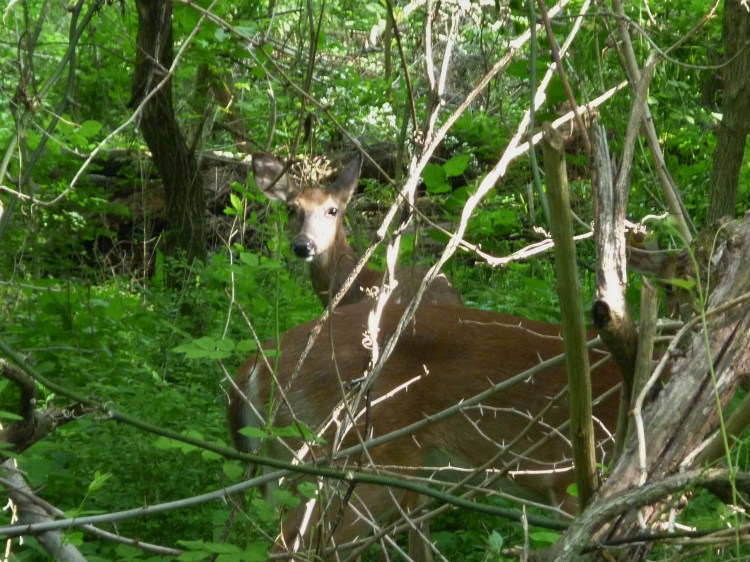
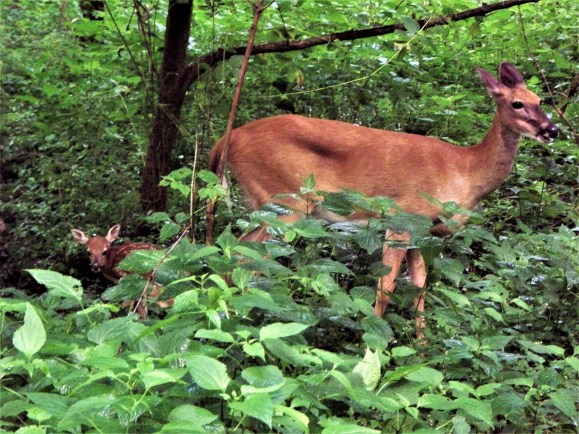
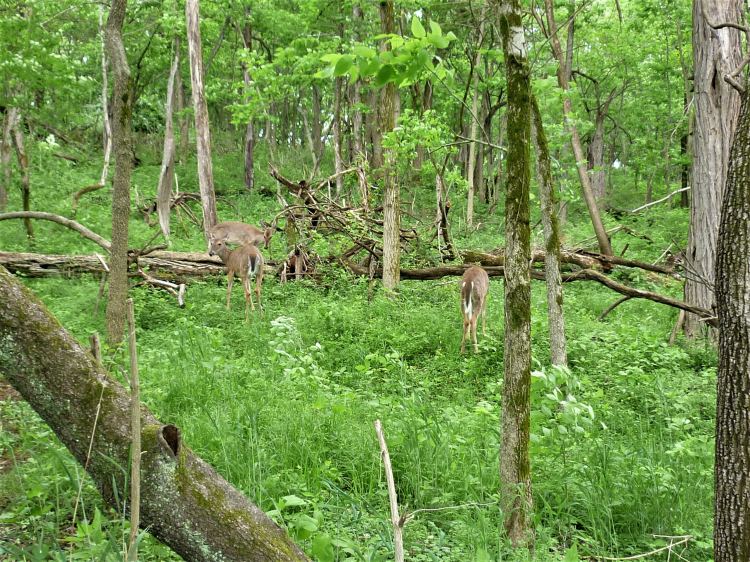
this doe’s baby(s) visibly moved as I took the pic
Our ecosystem engineers have been hard at work (eating) as they get ready to come out with this year’s new and improved model. Natural selection will choose the best of these, just to keep up with a changing world. The most useful adaptational tweak for deer in our forest would be the desire to eat invasive plants only – thereby ensuring an endless food supply.
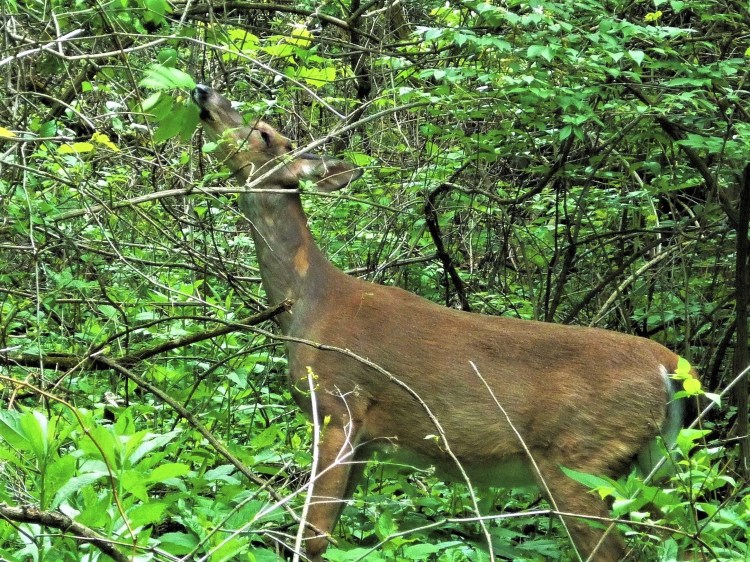
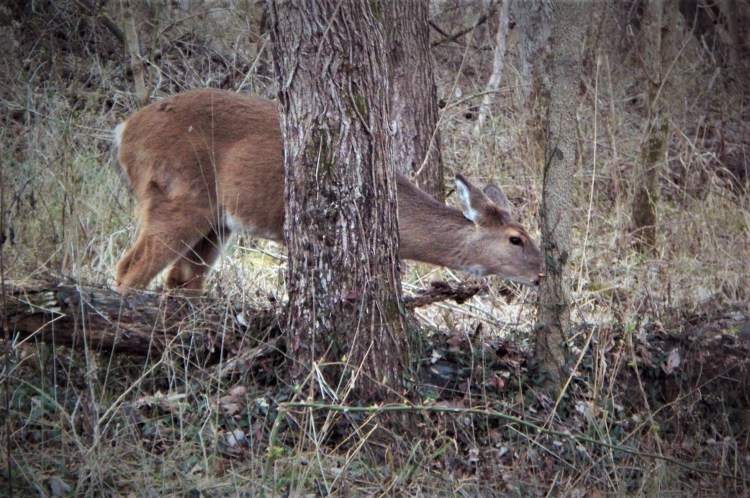
The same doe reaching for a mouthful of hackberry leaves
The birthing will be soon, and many mamas will have twins, the usual number for a mature healthy doe. At this rate of increase, it’s easy to see how White-tail numbers went from an est. 300,000 in the 1930’s to as many as 30 million this decade. It also makes you wonder just how many more deer are added to our small urban forest each season.
This doe gave birth to her fawn just downhill from the nature center last spring
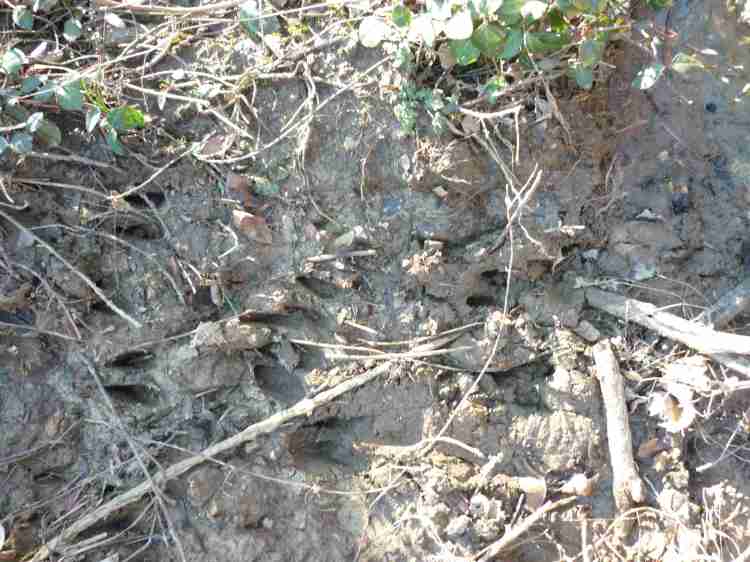
I still remember when my husband and I saw the first deer tracks at Beargrass Creek SNP. It was only eighteen years ago, and how excited we were – big wild things in the city! (this was before coyotes really moved in). It’s hard to say how big our deer herd is now, except that it’s bigger each year. The only time I’ve had a chance to count a bunch of them together is in winter – a few years ago I counted over 20 as they straggled up to the Nature Center in the evening, to browse the plantings.
With this many large herbivores around, you know they have to be eating more than your hostas. And for deer, eating is mostly what they do. In contrast to predators, who catch (if they’re lucky) a high protein, high fat animal meal that satisfies for awhile – deer must continually process large amounts of greenery.
Like other ruminants, White-tails re-chew what they eat as a “cud”, and can digest even cellulose with help of bacterial microbes. To stay well nourished they must seek out a variety of plants; but their unerring ability to find the few “highly preferred” ones amongst all the others is remarkable (and very frustrating to gardeners and tree planters!)
a yearling browsing on Wintercreeper
Which brings us to the nitty-gritty of this post – when deer are above the carrying capacity of their habitat, something has to give. The deer in our forest are not exactly starving, and are still avoiding most low preference foods such as the invasive Bush Honeysuckle and Privet. But sadly, at the top of the “highly preferred” list is the new growth of young trees such as Hickory, Oak, Hackberry, Sugar and Red maple, Tulip tree, Black Cherry, Elm and Ash. That is – all of our future forest trees (with the exception of weedy Box Elder, which is little browsed). My tongue in cheek label “ecosystem engineer” is quite accurate – White-tails are changing the make-up of future forests.
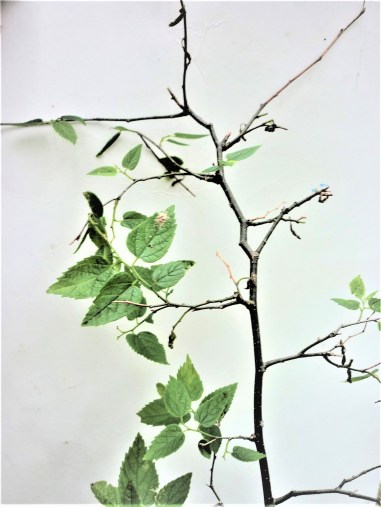
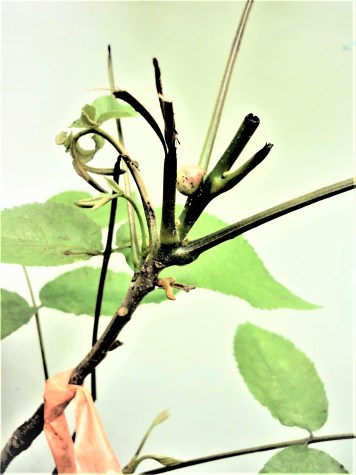
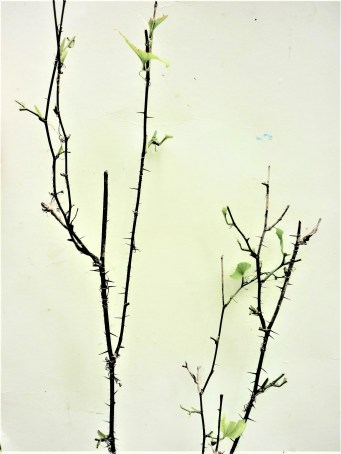
To illustrate this point, here’s a gallery of young trees that have been browsed repeatedly and will likely never get big. The trees in the pics are all under six feet; the magic number a tree’s height must exceed to be home free. The only way these species could mature in our forest under current conditions would be with a protective cage.
Tuliptree
Red Maple
Red Oak
Hackberry
Bitternut Hickory
Greenbriar (Smilax) – not a tree, but definitely a preferred browse
So what will future forests look like if deer continue their numbers trajectory? Barring a population crash due to disease (such as CWD) – we can expect eastern forests of the future to have a very different composition. As old or diseased trees fall, and fewer young ones replace them, a more open, shrubby landscape may prevail. Unfortunately this will also mean an open niche for non-native plants like Bush Honeysuckle, Privet, Buckthorn and others.
beautiful grassy woodland at BCSNP with very few young trees
But I’m a “make lemonade” kind of thinker – even in a deer-engineered forest there are opportunities for native plants that the deer detest. Think Pawpaw and Spicebush; both are increasing quickly at Beargrass Creek. These two mainstays of the eastern forest solved the browsing dilemma ages ago – their unpleasant tasting chemical compounds even transfer protection to the caterpillars of two butterflies that feed on them, the Spicebush Swallowtail (Spicebush) and the Zebra Swallowtail (Pawpaw).
five year old Spicebush produces its first berries
Tastier natives that grow in clumps, such as Elderberry and Smilax, can be protected with mountains of brush thrown around them.
Elderberry patch sheltered from deer for four years
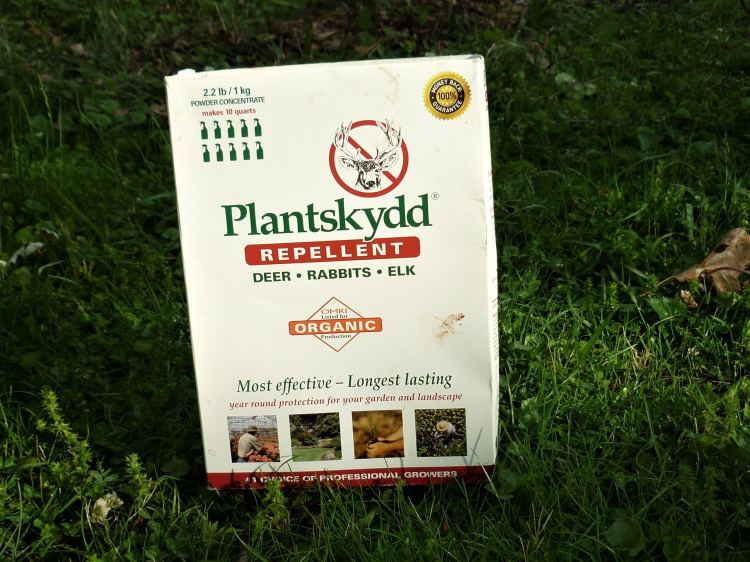
And then there’s deer repellent. This one is my favorite.
If it seems a bit over the top to go around the forest spraying this foul-smelling liquid, then so be it. We all have our foibles – I like to see young trees survive.
Pretty soon the does will be dropping their offspring, and little fawns will leap up when I least expect them (once they get their legs, they don’t lay still when their cover is blown).
Do you know your city? From the outside yes, but what about the hidden places? The places you don’t go unless you’re homeless, or want to disappear or do something illegal. A creek flows through the city; its channel is such a place. Its final fate, like most urban drainages; to transport storm sewer water. The South Fork of Beargrass Creek could be called the “ugly fork” – it’s not the one people think of when they think of Beargrass Creek. That other stream, the Middle Fork, flows through a beautiful city park, and is featured in postcard-pretty images.
But this is the South Fork, and though it gives our forest its name, there is little to recommend this dirtiest and most degraded of Beargrass’s three forks. What happens to a stream when it becomes entrapped in the urban matrix? In this photo essay we’ll visit one small section to find out.
At the back of a parking lot off of Eastern Pkwy, we part the leafy branches, and step into another reality. We’re at the top of a steep, trash strewn embankment, in heavy growth of huge bush honeysuckle – below are the concrete walls of the channelized creek.
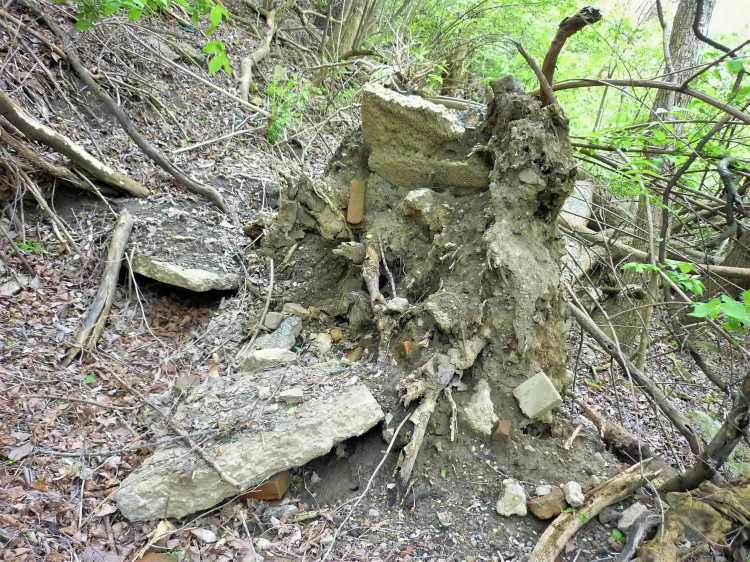
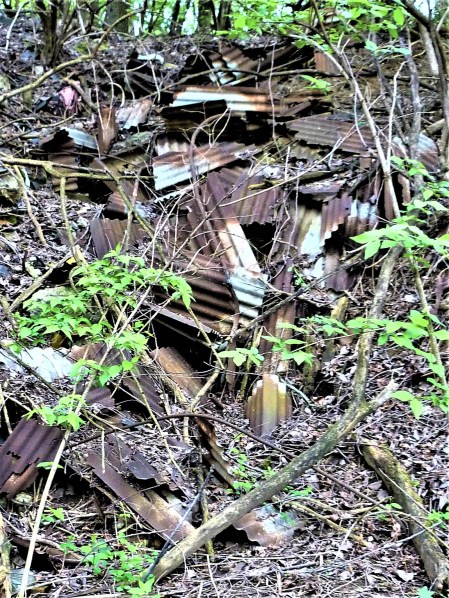
Jutting from the hillside are chunks of brick and concrete – the remains of old buildings dumped here to shore up the embankment. Very little plant cover grows in the deep shade of the bush honeysuckle.
Further down, the dumped material covers the whole hillside in places, as trashed as any roadside drop-off in Appalachia. On the bright side, it’s good cover for snakes if there are any.
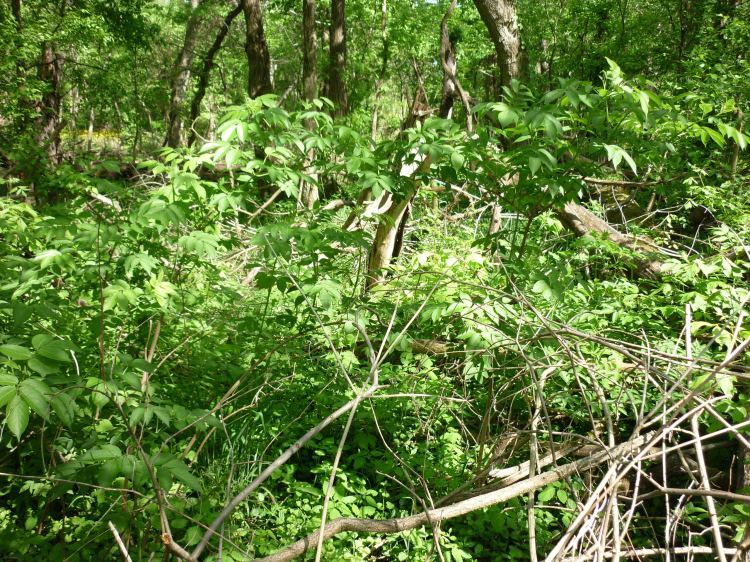
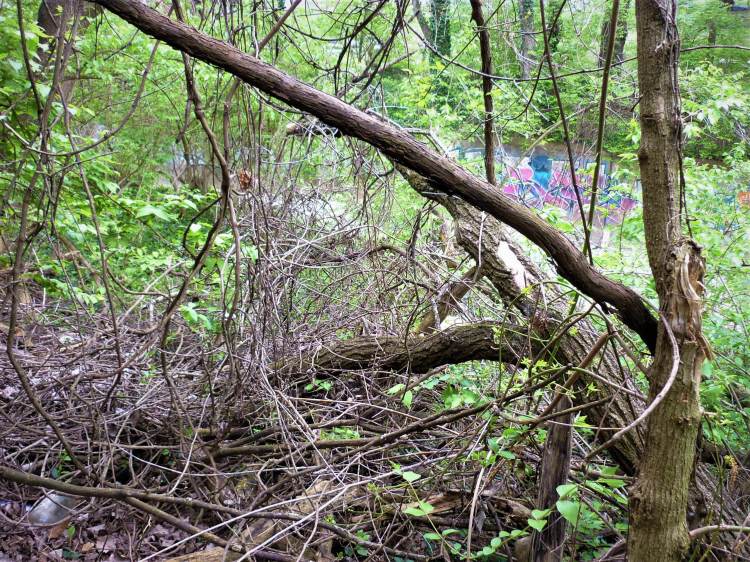
Closer to the creek, a dense tangle of down trees and grapevine is surely great wildlife habitat. Despite the degradation of the South Fork, there is this – it’s a wildlife corridor, a way for foxes, coyotes, deer and countless others to safely get around.
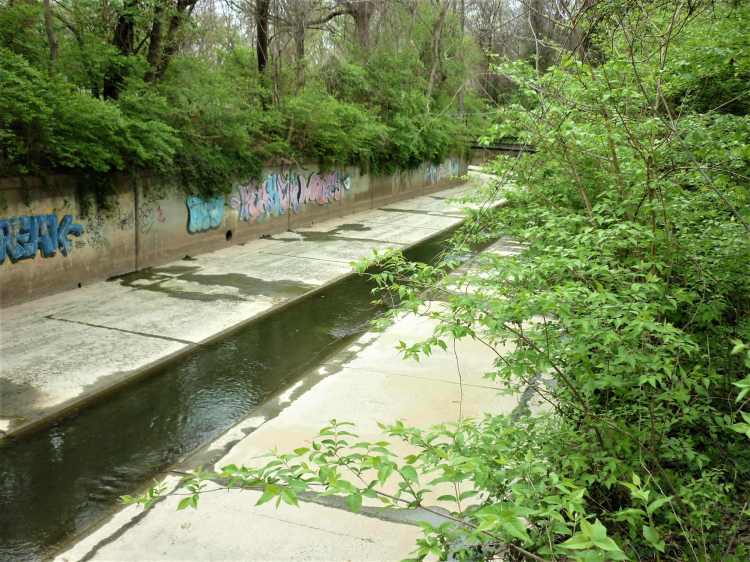
Stepping on the brink of the concrete channel, we’re rewarded with a graffiti gallery as engaging as anything in a museum. In fact, more so – it’s people’s art, a work in progress with many makers, varnished by the dirty waters of the South Fork.
Now we finally see the “creek”. Can anything live in this water? In the upper reaches of the South Fork, the stretches that wrap around our forest, I’ve seen carp and sunfish, red eared sliders, snapping turtles. If they get swept into this channel, it’s a one way trip to the river. When a creek loses its ability to meander and carve the landscape, when it loses its riparian zone – it loses its life.
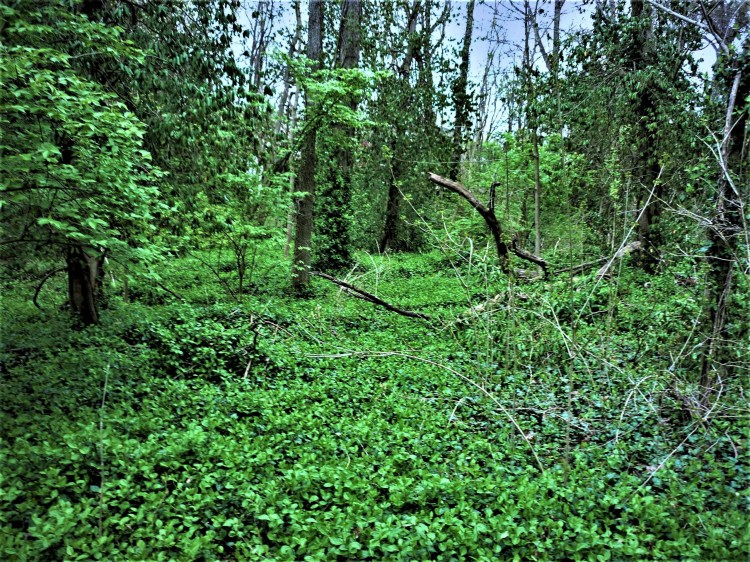
The floodplain widens, and we tramp through a dense monoculture of Wintercreeper, Euonymus fortunei. It’s crept down the slope from the backyard of a grand home on the hillside above. A perfect example of why this is one of the worst of our forest invasives.
But on the edge of this takeover a colony of wild ginger thrives, apparently holding its own.
At this point we turn back, our way blocked by an impenetrable tangle ahead – a homeowner dumps their brush here.
It’s a bit hard to mentally process this landscape – so urban, so wild, so degraded, so valuable. So hidden in plain sight.
But worth seeing. I encourage you to get out and explore our urban wilds, it’s an adventure you won’t forget.
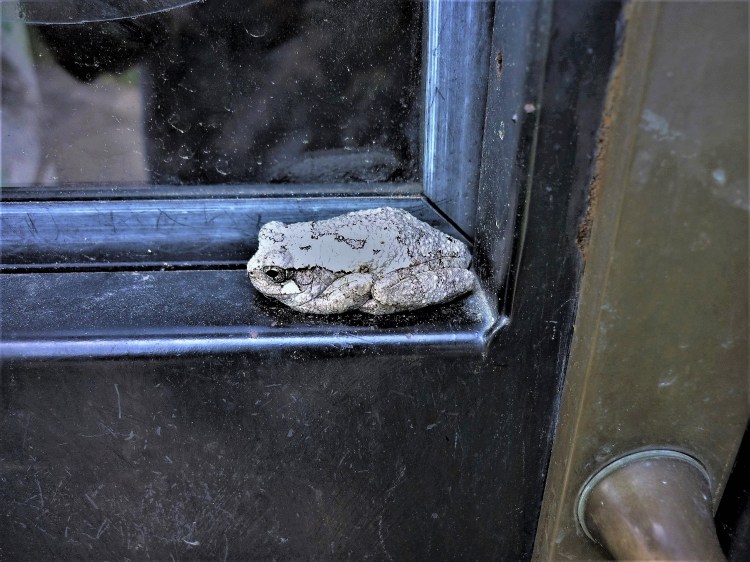
Have you met Hyla chrysocelis, Cope’s gray tree frog? I met this little one perched on my front door yesterday, where it had climbed with it’s sticky toe pads. It stayed all day, quietly enduring our in and out traffic. Another amazing urban-tolerant species, Cope’s can breed in swimming pool covers and backyard ponds. It descends from it’s arboreal habitat to breed, and we can hear it’s mating trill at this time of year. The sound is a bit like a “raspberry”, or Bronx cheer.
a closer view of warty little, color-changing Cope’s gray tree frog
This was not my first up-close encounter with H. chrysocelis – in springtime it can be observed (and heard!) at night in the water feature pond at the LNC. And two summers ago when the pump broke, hundreds of tiny tadpoles hatched in the warm, still water. You can make breeding habitat in your yard just by keeping a good-sized container of shallow water out, (using mosquito dunks to prevent another type of breeding).
But the most remarkable encounter occurred a few months ago in our forest, when I accidentally dug up (blog readers – sense a pattern?) a Gray tree frog in hibernation. Thankfully I saw the little creature and didn’t hurt it with the shovel. The frog couldn’t move at first and I was able to pick it up, guiltily, just to verify what I’d found.
In my hand, I could see the bright yellow on the inside of its back legs, a positive ID for both Hyla chrysocelis and Hyla versicolor. Both species of Gray tree frog occur across much of the eastern US – but in KY, Cope’s gray tree frog, H. chrysocelis is much more common and found in most counties.
It leads one to wonder if they can hybridize, and according to the Ky Dept of Fish and Wildlife website, they can. Leading one to wonder how and why they diverged from a common ancestor, and whether they could become one species again. For a very scholarly, but very interesting research article on this topic, google this:
“Polyploid Hybrids: Multiple Origins of a Tree Frog Species”
And watch for frogs on the door!
(Also watch for my upcoming blogpost “Trashed – Strange Beauty along the South Fork”)
Actually this post started with the Big Guy (turt #185) in the pic above, who was crunching down on a hapless snail when I found him, the remains of which can be seen hanging out of his mouth.
And then I saw the Jack in the pulpit not five feet away, and remembered something I had read.
Arisaema triphyllum with tiny flower spider onboard
Box turtle #185 and many others have lived in this meadow near a spring for a long time. Jack and many others like it have grown in this meadow for a long time.
Jacks have been reviving in this meadow since we cut down the bush honeysuckle, but they grew here before there was honeysuckle in this forest. And it’s possible that turt #185’s mommy or daddy planted them.
Jacks’ fruiting stalk conveniently flops over to the ground when it’s berries are ripe, making it easy for box turtles to get to them. Every part of the plant contains calcium oxalate crystals, making it potentially unpalatable to some turtles – yet one captive boxie ate and voided over 400 Jack in the pulpit seeds! (that’s what I remembered reading)
We do know that Box turtles are the only known vertebrate disperser of Mayapple seeds (if you don’t count hikers who might snag a ripe fruit). They also eat Pokeweed berries, Spicebush berries, and many other berries. They love Mulberries and can often be found with purple-stained faces near a tree with ripe fruit in our forest.
But back to #185, who had to endure my documentation of his carapace and plastron (top and bottom).
One unhappy turtle
As soon as I released him, he trundled off faster than you would think a turtle could go – not stopping till he concealed himself under the fallen branch in the pic below. This explains why, when you see a box turtle and try to show it to someone else a minute later, it is gone and cannot be found. They wisely head for deep cover once they’ve been spotted.
Checking my record books at home, I noted that he has been seen several times in this general area. Even found a pic from several years ago, of this same box turtle on top of a female, obviously mating, in the little stream near where I found him!
The stream habitat is the key to everything going on in this meadow. It begins as a cold spring emerging from beneath the rock in the pic below. With a bit of earth moving, it’s been restored to hold water in a few pools, and now flows through the meadow year round. A wealth of moisture-loving plants grow around it, making for great snail habitat.
So we circle round and round: stream – plants – snails – Box turtle – Jack in the pulpit – stream – plants – snails – etc. etc…. Of course I’m missing a million tiny links in-between but you get the idea – pull one link out and the merry-go-round starts to break down.
Watch for more box turtle posts – perhaps I should rename this blog ” Box turtles of Beargrass Creek”
A female boxie, (#186) with a flower stuck to her chin



![oldboxturtle[1]](https://oneforestfragment.com/wp-content/uploads/2017/05/oldboxturtle1-e1495372955786.jpg?w=438&h=553)









![Celastrus_orbiculatus_5487341[1]](https://oneforestfragment.com/wp-content/uploads/2017/05/celastrus_orbiculatus_54873411.jpg?w=571&h=428)







![Cave_Salamander_(Eurycea_lucifuga)[1]](https://oneforestfragment.com/wp-content/uploads/2017/05/cave_salamander_eurycea_lucifuga1.jpg?w=750)












 one forest fragment