As spring races on, fueled by amazingly warm temperatures, one species after another awakens and joins the party in our tiny forest fragment.
Box turtle #183 has the distinction of first turtle observed above ground this year, on 4/9. It’s likely I would have found an earlier one, but we’ve been out of town for three days. (#182 was dug up accidentally, as you may recall). The date of her emergence is pretty much in line with my box turtle first spring sightings at BCSNP from the last three years: 4/8/14, 4/12/15, 4/20/16.
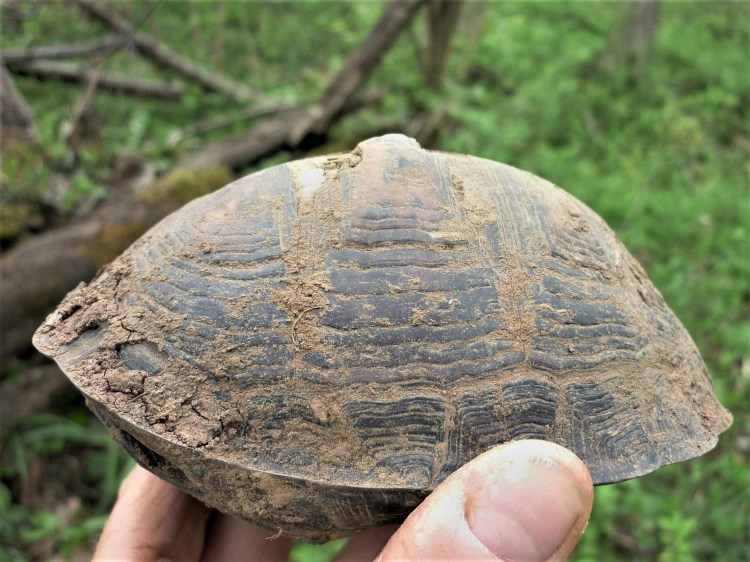
Early turt #183 is an older female with a high-domed carapace and heavy wear on her scutes. Still caked with mud, she must have emerged recently.
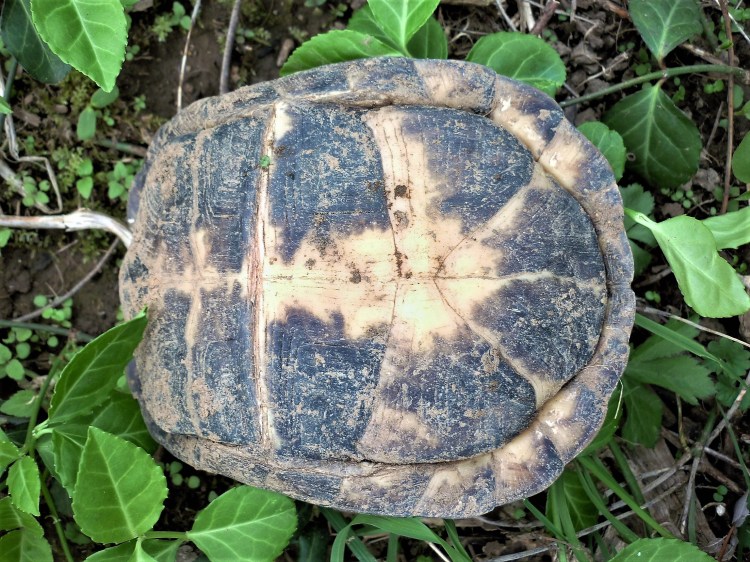
Her plastron (underside) has an attractive bold pattern, that will make an easy ID if I see her again.
She has survived an injury to her carapace, and it appears that some of the underlying bone is protruding. A partially healed mower cut?
Looking through my Box turtle images, I see no record of her, and she has not been marked by my dot of nail polish. Is it possible, in an area I visit and work in all the time, she has completely escaped notice for years?
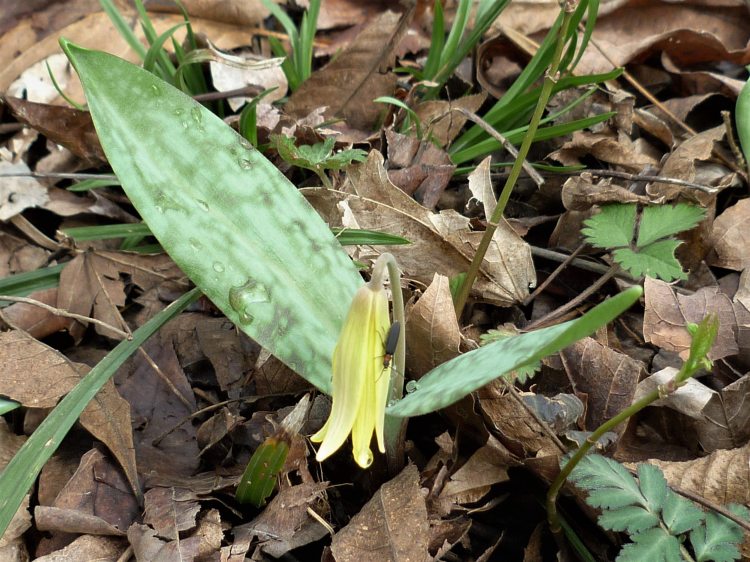
To inject a little flora into this mostly fauna post – a Trout lily nestled alongside shiny, reddish little poison ivy leaves. Just below the Trout lily are the first tiny leaves of Spotted jewelweed. There appear to be some pollinators inside the lily flower, behind the anthers with fresh orange pollen.
From the same ephemeral patch, the golden green of young Solomon’s seal leaves (in our forest this plant is usually bitten off by deer when it grows tall flowering stems – hence my nickname “deer asparagus”). Although this plant is experiencing a revival in our forest, it’s rare to find an intact flowering stalk.
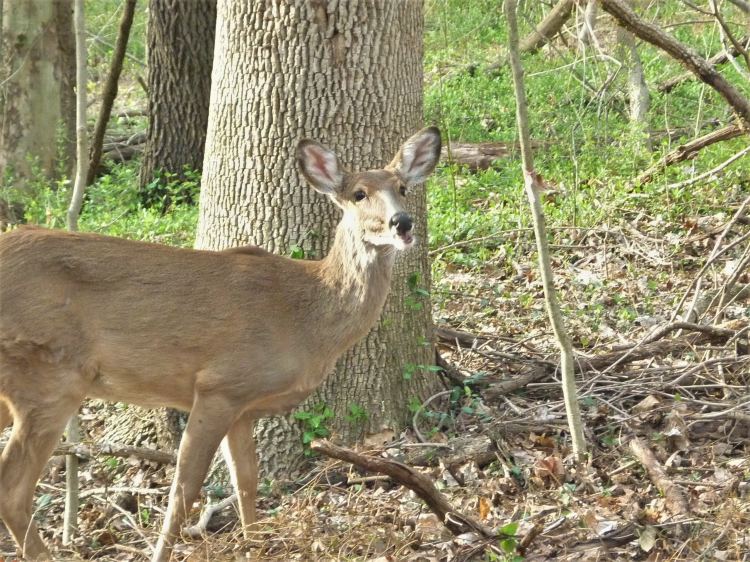
This doe is standing in the spring ephemeral patch, munching on something…
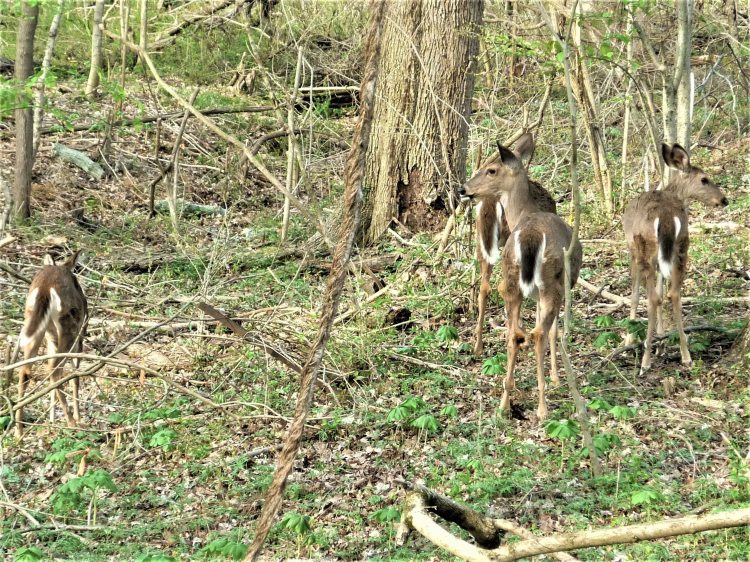
…along with several members of her family. Trampling alone causes soil erosion and damage to wildflowers with this many deer in the forest.
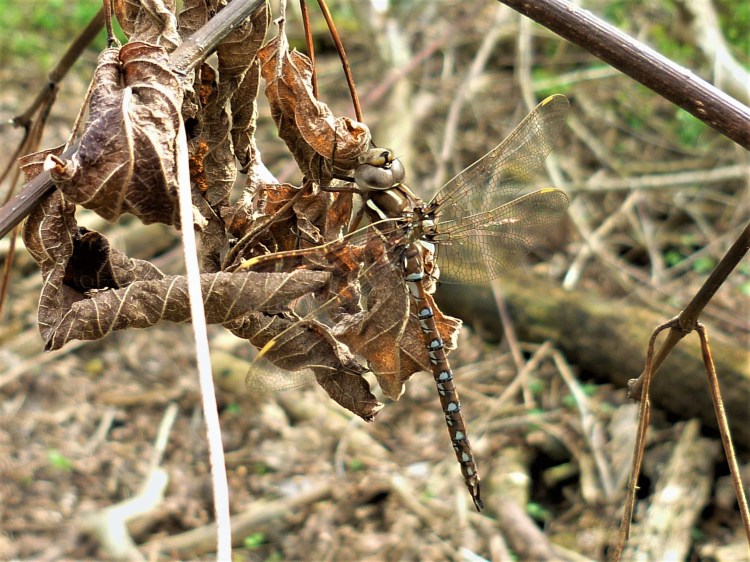
The lovely brown Springtime darner dragonfly, Basiaeschnea janata, blending well with some dried leaves (thanks to Dr. Victoria Prescott for the ID). One of the earliest emerging dragonflies, it favors slow wooded streams. This one must have recently emerged, since it clung to the leaf for some time.
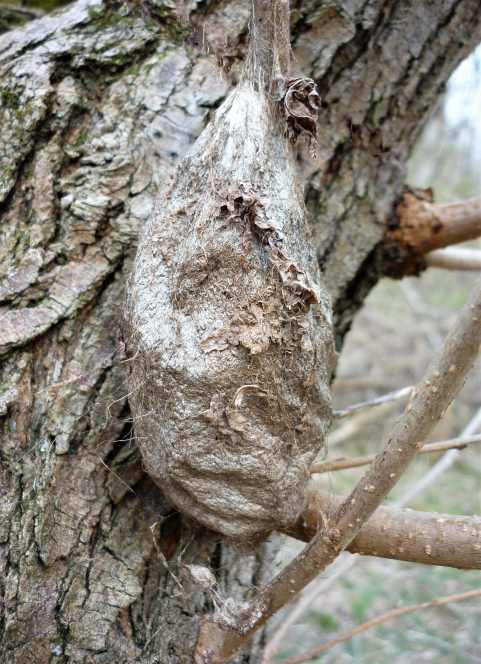
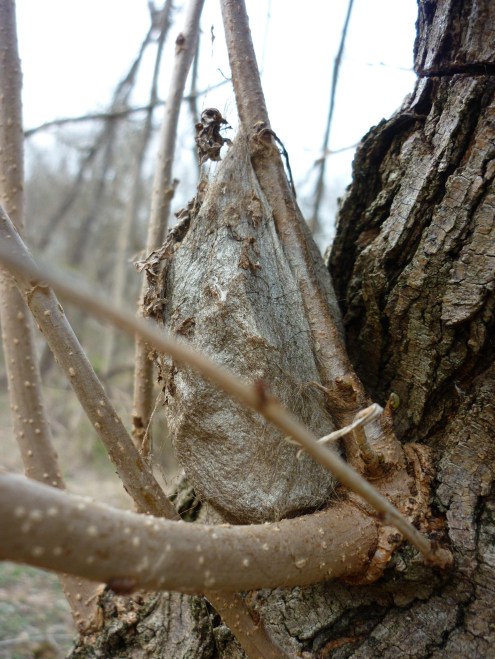
Would you know what this was if you saw it hanging from a branch? Considering how well this giant silkmoth cocoon is camouflaged, we’re not likely to see it at all. This one was spun by the Cecropia silkmoth, Hyalophora cecropia. The caterpillar feeds on Apple, Birch and Maple – and perhaps Mulberry, the tree species this cocoon is attached to.
Time to get out and make your own discoveries – spring is flying by.
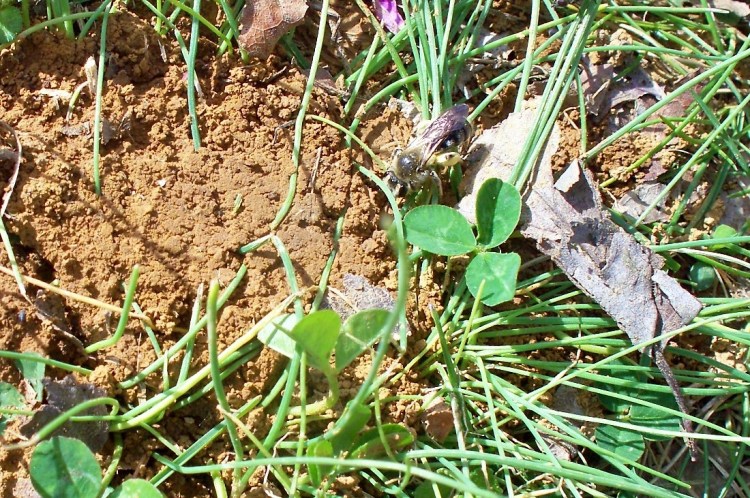
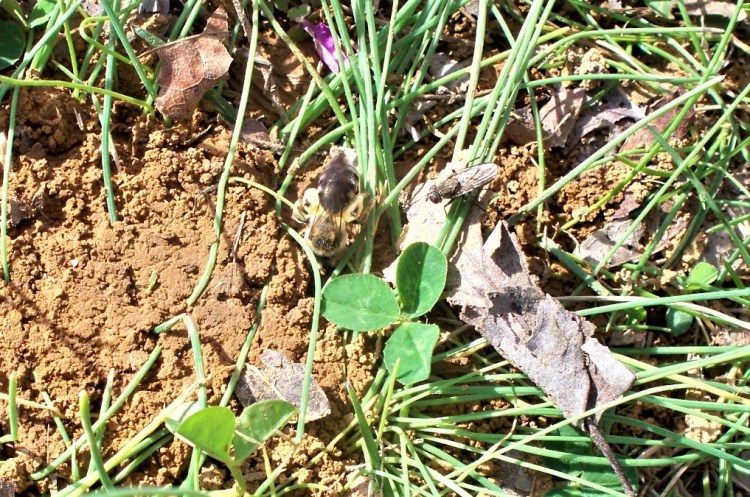
Fuzzy ground-nesting Colletes inequalis female bearing pollen to her nest
in your lawn…
A moment later she disappeared into her nest hole
…for native bees.
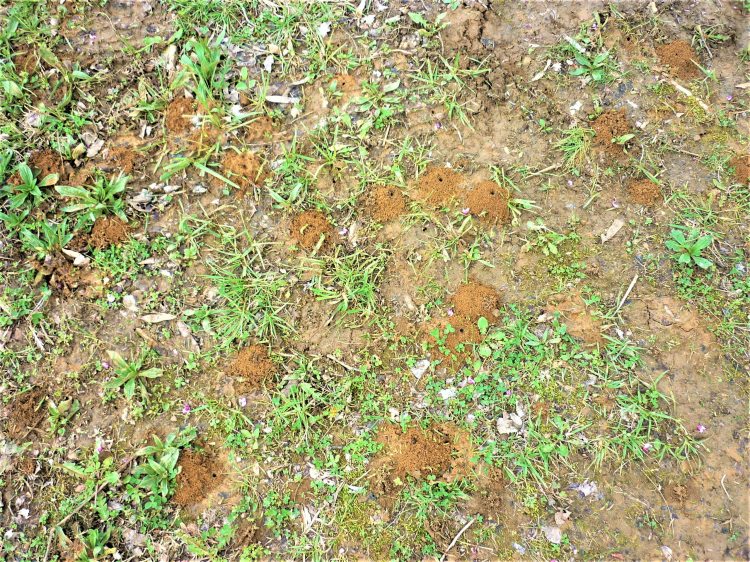
What are you willing to do for native bees? Of course you’d be happy to plant lots of beautiful native plants for nectar and pollen. But how about allowing some of your yard to look like the pic below? (Ant hills these are not).
On the front lawn of the Louisville Nature Center, under the blooming purple redbud tree, lives a city of ground nesting bees (above pic). The tree’s shade has suppressed the growth of grass, making it ideal for burrowing. Most of the hundreds of bees appear to be cute, fuzzy Colletes inequalis, the “polyester bee”. (If you want to know the reason for it’s name, google this great article – “Washington post, Polyester bee: born in a plastic bag”).
The half-inch long females have each dug their very own vertical tunnel to an amazing one and a half foot depth, and are busy installing nest chambers in the walls. Plenty of males are hanging around, mating with the females. There is continual traffic back and forth from the redbud tree and a nearby blooming Serviceberry bush (that always bears an amazing abundance of fruit). It’s a busy, cheerful scene – the kind that unfortunately would send some folks running for the pesticide spray.
It’s our loss if they do, since many native bees are more effective pollinators than honeybees. They’ll only be visible and busy for a few short weeks in early spring – by mid April these tiny bees will be literally worn out and tattered, having accomplished the goal of creating the next generation.
So, are you ready to prepare a place for native bees in your yard? If you neglect your lawn as much as I do, you may have nesting ground bees already – most any patch of dry bare dirt will do.
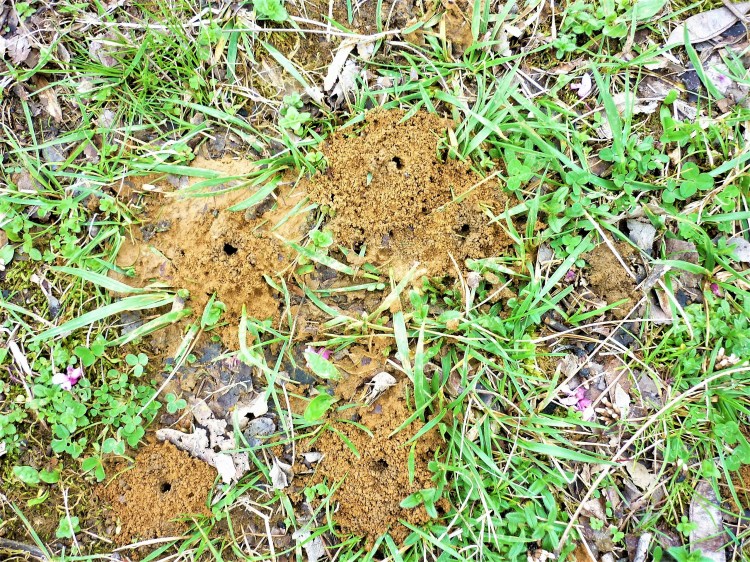
Close- up of Colletes nests at the LNC. The opening are wider than those of ant colonies
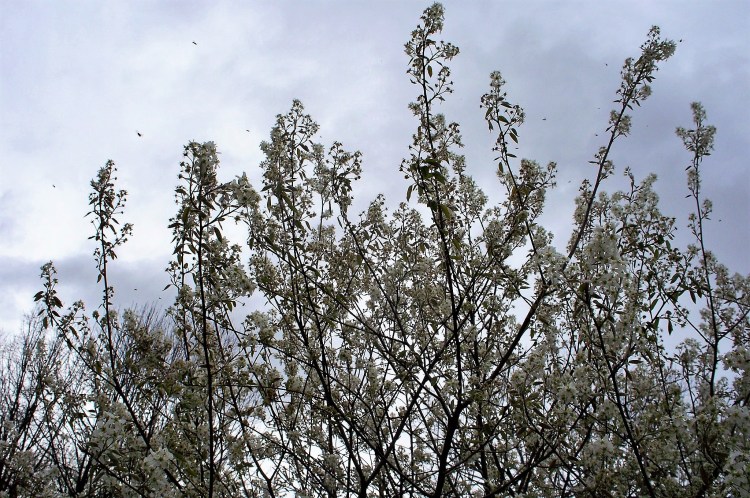
If you’re lucky, you may then see a sight like this (pic below). The air is alive with hundreds of tiny bees swarming around this Serviceberry bush.
More bees you might see…
This beauty (likely a Halictus), observed in our forest on Round leaved ragwort (Packera obovatus), might be confused with a Yellowjacket wasp if it were not so tiny.
“Pure green magnificent bee”, Augochlora pura, our friend from the previous post.
These lovely little ground nesting bees, and many more like them, can help pollinate your flowers, your berry bushes, your garden vegetables. All they need is a naked place in your lawn!
Is a picture worth a thousand words? Well it inspired me to write this post. Don’t think I can make it to 1000 words though, would likely bore you if I could. But let’s meet (Trout) Lily, Erythronium americanum and (Pure green magnificent) Bee, Augochlora pura. They’ve been springtime friends for eons, since they really need each […]
Imagine these bottomlands carpeted with spring ephemerals of many species – an early April buffet laid out for the pollinators, rushing to bloom before the leafy canopy closes. Once it was so in this place. And though the nature blogs will be posting amazing pics of gorgeous spring wildflowers this time of year, it’s a miracle we have any left. These plants are up against tough environmental challenges under the best of conditions, since they depend on the short window of forest sunlight available in early spring.
I said in an earlier post there would be no extravagant wildflower displays at Beargrass Creek SNP, but that’s not entirely true. Fragments of the former glory can still be found here and there, but most areas of the forest are barren of spring ephemerals. This leads me to wonder – why did they survive in this spot or that one, but nowhere in between?
Only a few small patches of Sessile trillium remain in our forest.
Spring ephemerals are one of the main casualties of forest degradation. Colonies can be hundreds of years old – once they’re decimated, recovery (if it occurs) can take centuries even under the best forest conditions. Seeds are dispersed only a few feet from the parent colony by ants, in the mutually beneficial behavior called myrmecochory.
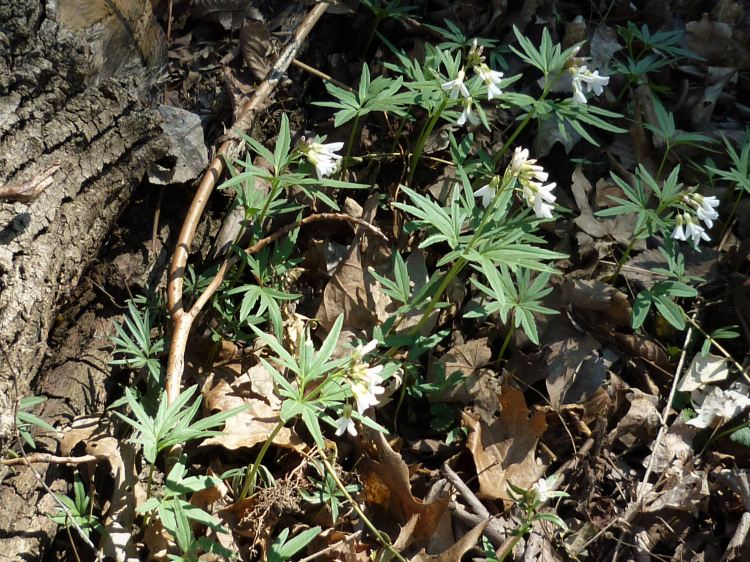
Cut-leaved toothwort has persisted and even recovered (post bush honeysuckle removal) a bit better in our forest than other ephemerals. In parts of the bottomlands, many small patches are blooming now.
vivid Privet leaves – this plant spreads quickly by root suckers
For the most part, what passes for spring in our forest now is the neon yellow-green flush of privet, bush honeysuckle and wintercreeper new leaves, outpacing everything else by weeks. I dislike spending so much time tediously removing these non-native invasive plants – but rather than demonize them it’s important to remember how they got here.
the common groundcover Wintercreeper, Euonymus fortunei
It is hard to talk about “native” plants without implying that they are morally superior. And “invasive” plants are decadent, uber-competitive bad guys that just want to take over the forest. But this is a complicated issue – the plants we now call invasive were introduced into our home landscapes as horticultural varieties of wild species from somewhere else. These varieties were selected for features such as fast growth, hardiness, and heavy flower and berry production. So we created this monster ourselves.
Wintercreeper berries from a vine in my yard or your yard or anybody’s yard may have started the embedded and spreading patch in the pic above. While our native ephemerals can take years to advance a few inches, one Wintercreeper vine runner can grow several feet in a season.
But exactly how did this happen, the replacement of one flora with another? Those landscaping standbys – Privet, Bush Honeysuckle, Wintercreeper, Porcelainberry – are all massive producers of bird dispersed seed. But as usual there’s more to the story; invasive non-native plants are a relatively recent arrival to our forest, and populations didn’t really dominate until about forty years ago. There must have been something that set the stage for their invasion. In the case of our forest and many others, the land was left in a damaged state after hundreds of years of multiple use – livestock grazing, logging, wetland draining, agriculture, channelization of the creek, etc. No surprise that even when these practices ended, the former forests could not revive themselves. Soil erosion alone was a major factor – the steep gullied appearance of our forest’s hillsides is evidence of land once laid bare. The native seed bank was depleted, but now plants had been introduced to our urban landscapes that could tolerate almost anything. The birds took it from there…
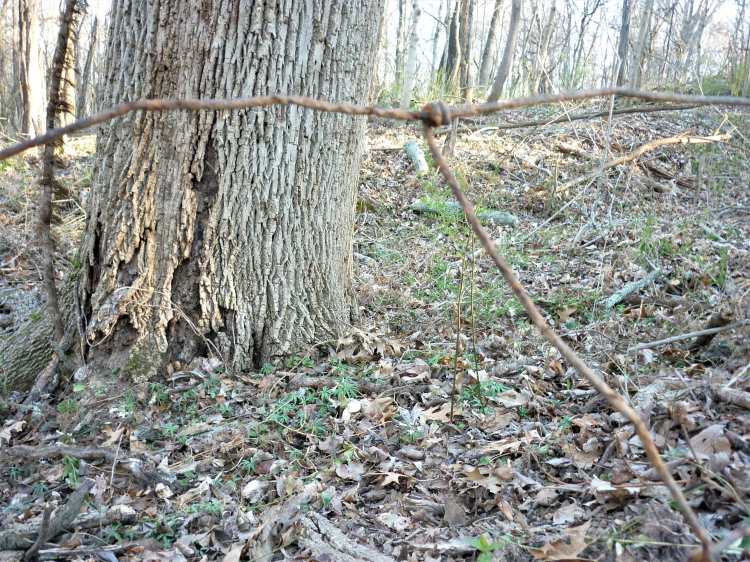
But back to that question I asked earlier – why did little pockets of wildflowers survive the invasion? The old rusty section of fence in the pic above is a clue. The land use history of our forest was determined by a patchwork of ownership, as well as the terrain. In some places, ephemerals are found thriving right up to an old fenceline, then dwindle out suddenly on the other side. Perhaps the sheep and cows grazed on that side? Very old Sugar maples seem to harbor the best wildflower colonies, perhaps their shade kept the site moist and reduced competition from other plants. There’s no doubt the best remaining sites have all the qualities that allow spring ephemerals to thrive – rich moist soil with old trees, near the base of slopes or in drainages.
But even the best sites have been severely degraded. We can be sad about how things are, or try to restore what remains. Post Bush honeysuckle removal, it’s sometimes a nice perk to see suppressed wildflower patches begin to revive. However they are quickly overwhelmed by the much faster growing invasives, which also respond to the increased sunlight. The pics below are examples of what volunteers are doing in our forest to restore and revive spring ephemerals.
Above – a patch of Trout lily is competing with Wintercreeper. Below – note the yellowing Wintercreeper leaves, sprayed with herbicide in late fall.
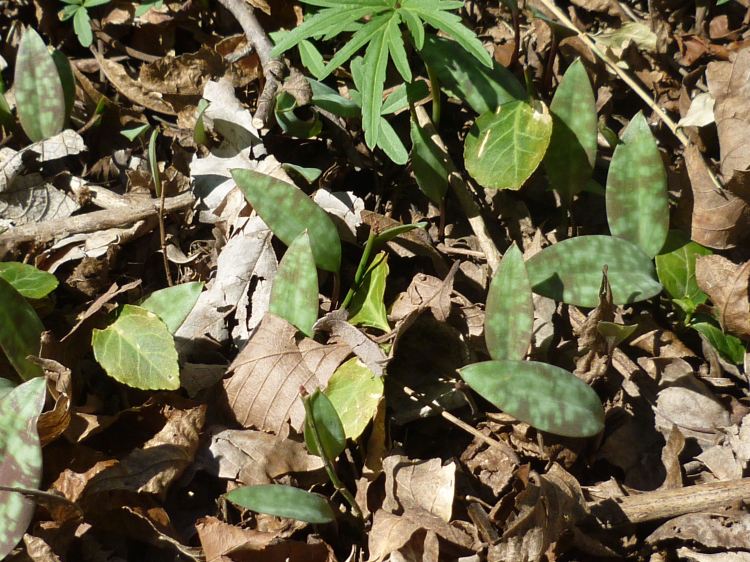
Above – a restored Trout lily colony. Wintercreeper was sprayed and hand pulled for 2 seasons. This colony could be centuries old.
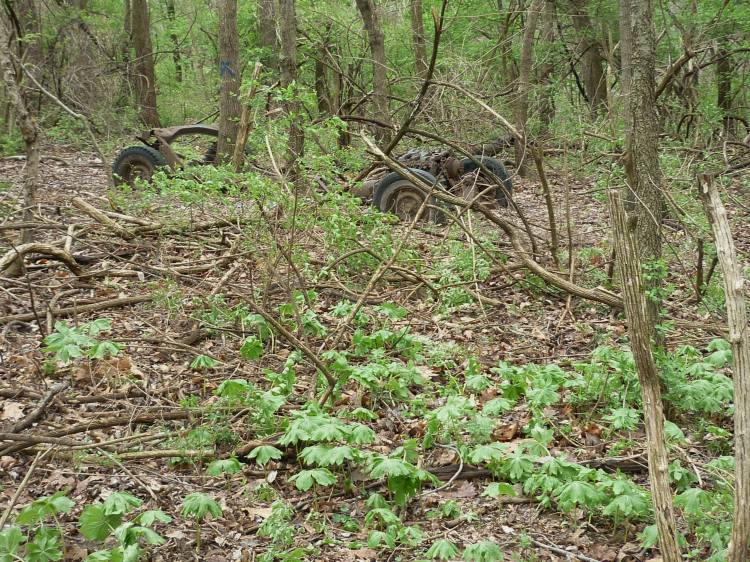
Today’s project! This nice patch of Mayapples has an old truck for company. They’re looking a little roughed up after two hours of pulling small Bush honeysuckle and Wintercreeper in their midst, then rerouting deer traffic around them.
These guys were literally waiting in the background for me to leave, so they could tuck in to the freshly pulled weeds.
Though not a spring ephemeral, the enthusiastic revival of spicebush in our forest is a bounty for early season pollinators. I’ve seen Paper wasps and many bee and fly species on it the past few weeks. Even watched a Phoebe snagging flying insects near blooming Spicebush.
Tiny insects are a very important part of the spring ephemeral equation too. Many have specialist pollinators from the mining bee genus, Andrena. Spring beauty, Trout lily, Waterleaf and Bellwort each have a Mining bee species (that retreats underground in summer as well.) I’ve never seen one of these and don’t know if they are in our forest, but will watch for them.
an accidental photo capture of a small beetle hoping to pollinate a trout lily
So what do these flowers mean to the overall health of the forest – are they really necessary, or just pretty icing on the cake? Wouldn’t those heavenly-scented Bush honeysuckle flowers do just as well or better than tiny Spicebush blooms? As noted above, flowers and their pollinators co-evolved over the eons. For many insects, the right flower’s nectar at the right season means survival.
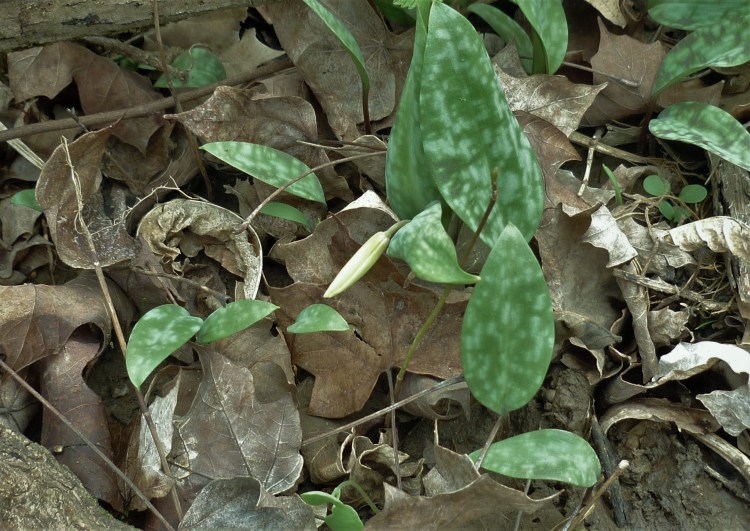
Today I found this Trout lily on the edge of blooming, in a small restored colony.
Admittedly spring ephemerals are not the most pressing problem on the planet. Sometimes I feel foolish for caring about something that seems relatively inconsequential. But I believe we have to follow our passion, if possible – and forest revival happens to be mine.
**************************************
For native plant lovers – Wild Ones Louisville is having a combined meeting/ potluck/wildflower garden tour, with the opportunity to dig some extra plants for your garden.
What party you ask? The one in the forest of course, which couldn’t roll on without a regular supply of dead and dying trees.
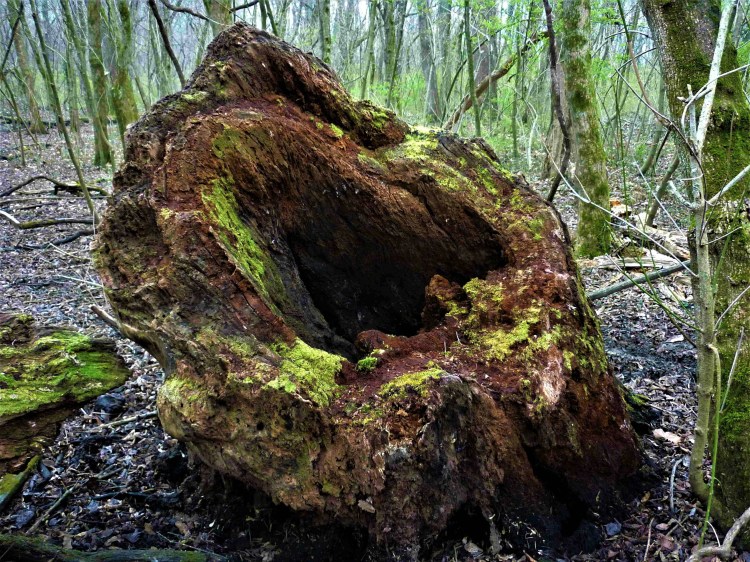
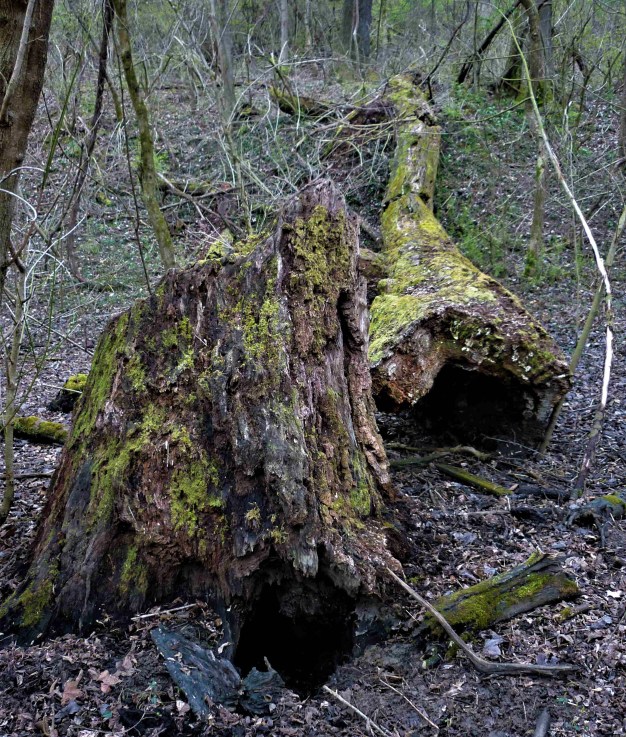
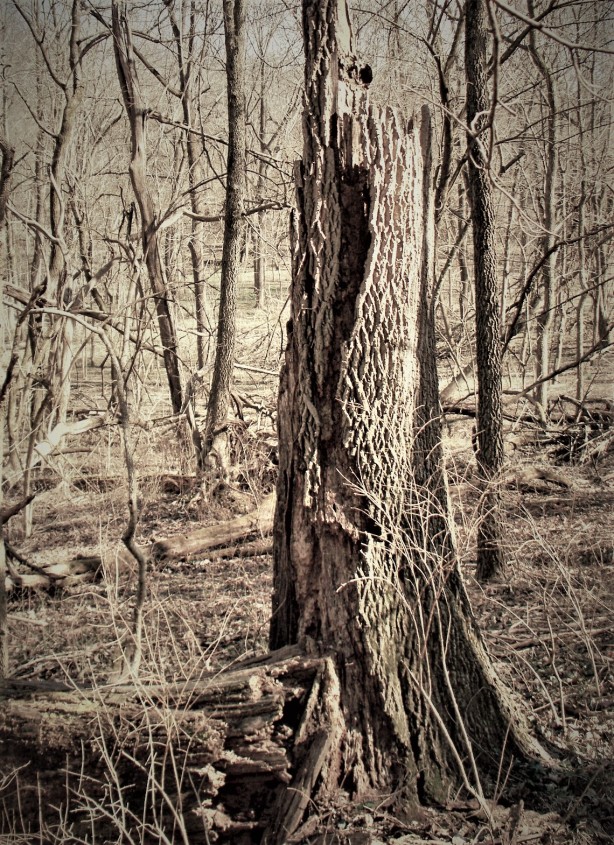
This massive mossy stump is so old I can’t tell what species of tree it is
“The truth is, the system depends on the death of trees…” Torolf Torgerson, Research Entomologist – US Forest Service
How many forest residents do you think really depend on dead and dying trees? Make a mental list … 10 species, 20 ? I’ll bet it’s way more than anyone might think. Just for starters – all species of woodpeckers, flying squirrels, bats, cavity nesting birds like Chickadee and Tufted titmouse, wrens seeking food, bears seeking food, salamanders, skinks, nesting owls, snakes, hibernating Box turtles, mice, voles, sleeping raccoons, nesting Wood ducks – not to mention the innumerable decomposers at the heart of it all that are food for the rest of the crew.
another view of same stump, with it’s trunk laid out on the hillside
Though our forest can be considered degraded in many ways, by one measure at least we score high – the vast quantity of what forest scientists term “CWD”, or coarse woody debris. Whether from windstorm or disease or plain old age, the number of toppled and decaying trunks is quite astounding (leading some visitors to wonder why we don’t clean the place up and sell that wasted timber!). We are actually quite rich, with a vast bank of stored nutrients to feed the future forest.
These masses of woody debris give rise to an amazing microbiotic community that supports the more visible species. Diseased and damaged standing trees are valuable too – woodpeckers need at least three kinds. Living trees with decaying heartwood to excavate nest holes, trees with dead tops for drumming, and trees with decay near the ground that harbor carpenter ants.
As with a new housing development, a whole network of life arises adjacent to and within the fallen tree. The various fungi and pair of colorful millipedes in the pic above live under a piece of rotting log.
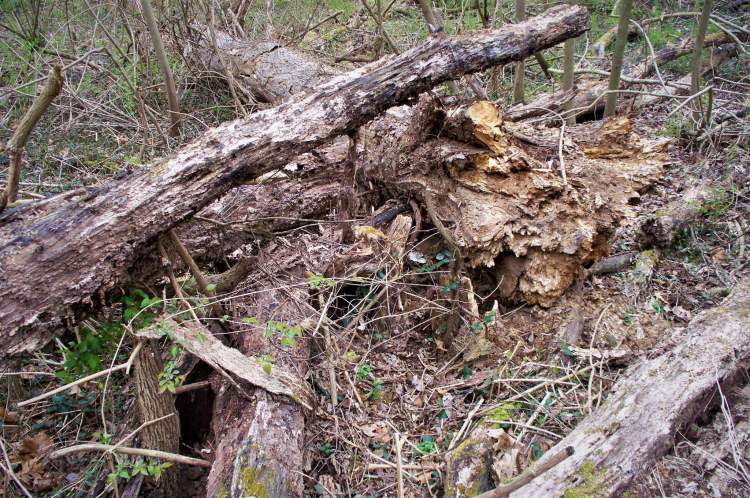
The tangle of fallen trunks in the pic below becomes a vibrant city of Five lined skinks in the summertime. On a hot day there is an audible rustling as one approaches it, the sound of many skinks running for cover. Orange throated males patrol the tops of the logs, females lie deep within coiled around their eggs.
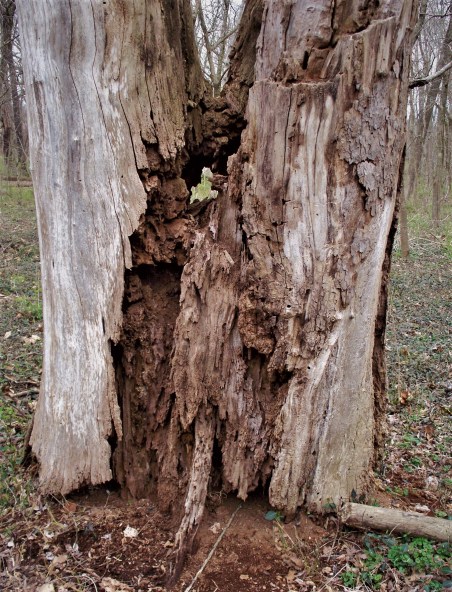
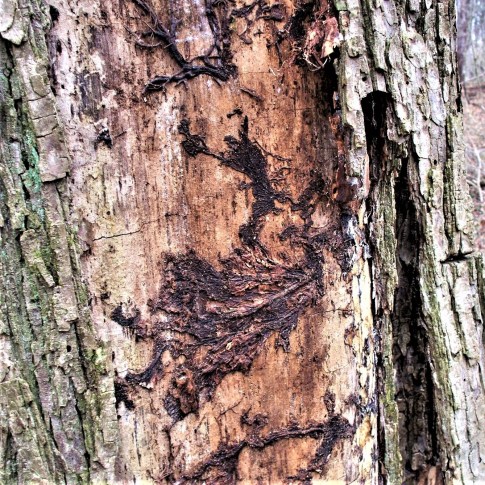
The pic above is an enlarged section of the stump below, which is leaking fine reddish humus as it’s slowly being dismantled. Forest scientists use a classification system for dead trees, based on their level of decay and colonization by other species. A dead but undecayed tree is class 1; by the time it’s an overgrown tree-shaped pile of humus, it will be class 5. In between these extremes, class 4 is the sweet spot for life. The bark and sapwood have sloughed off, and what’s left is quite porous and tunneled out. But the heartwood is still relatively stable, supporting a labyrinth of passageways.
a class 4 Black cherry stump
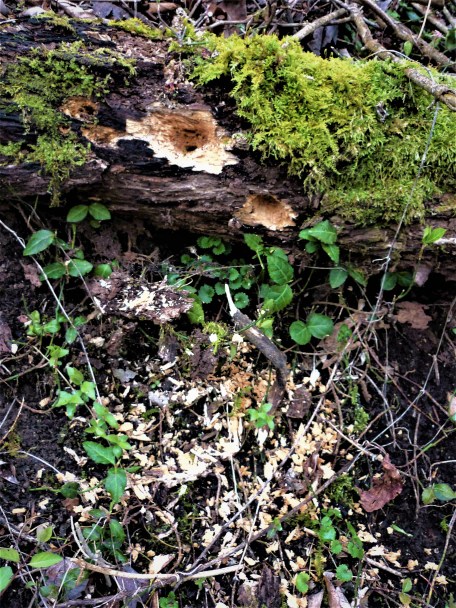
In a class 1 tree, woodboring beetles first breach the intact tree bark with their small exit holes, then woodpeckers carefully chisel larger openings seeking the larvae. Both create entry for organisms as diverse as fungi, voles, cavity nesting birds and raccoons – none of which can make their own holes. Fungi in particular quickly speed up decomposition, with their unique ability to break down lignin.
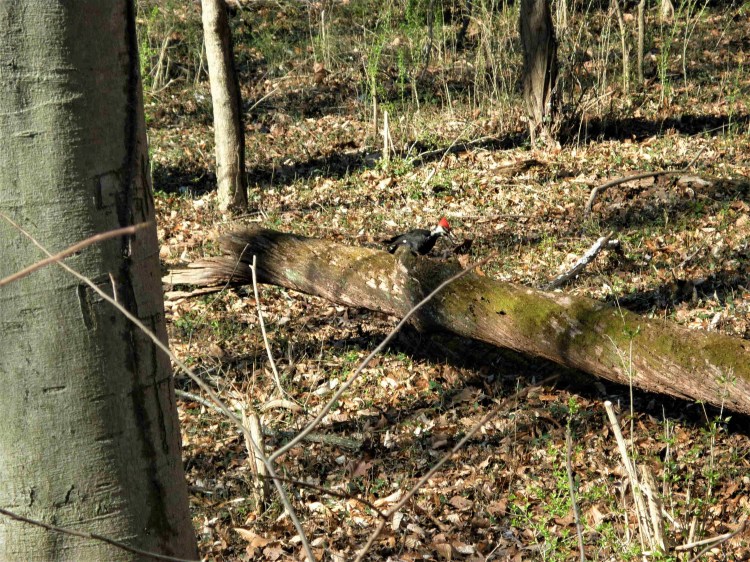
pretty bad pic of a female Pileated spotted a few days ago in our forest
Our resident Pileated woodpeckers have a very specific interest in deadwood – it’s where tasty Carpenter ant colonies are found. Armed with a formidable icepick of a beak, this largest north american woodpecker demolishes rotten logs ands stumps, and can even dig deep into the heart of living trees.
heartwood of an old Black cherry with remains of a carpenter ant colony
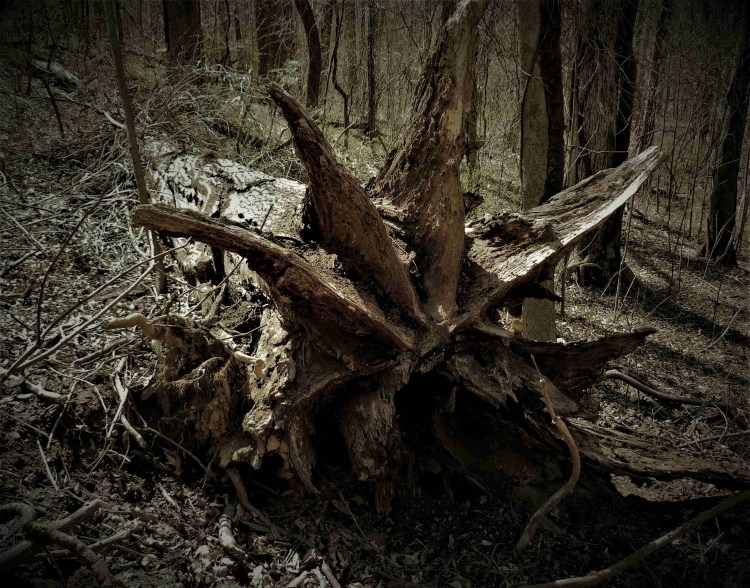
The trunk below is between class 4 and 5, as its lower part morphs into a rich pile of humus. One of my lasting nature memories from childhood was discovering the lovely feel and smell of humus forming at the base of an old tree. On our forest hikes when I give kids a small handful of this “almost soil”, a surprising number of them respond with reverence, even wanting to take some home in their pocket! Usually they just carry it a short way and drop it. And I tell them they’re helping to spread the wealth.
like ghostly fins, the buttress roots of this old Pin oak are finally exposed
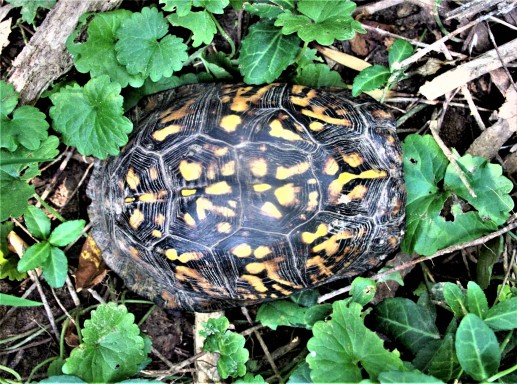
Yesterday I was thinking about box turtles. After such very warm weather it seemed likely that a few adventurous chelonians might be up and about already. Little did I know that today I’d be the cause of one poor turtle waking up rather suddenly.
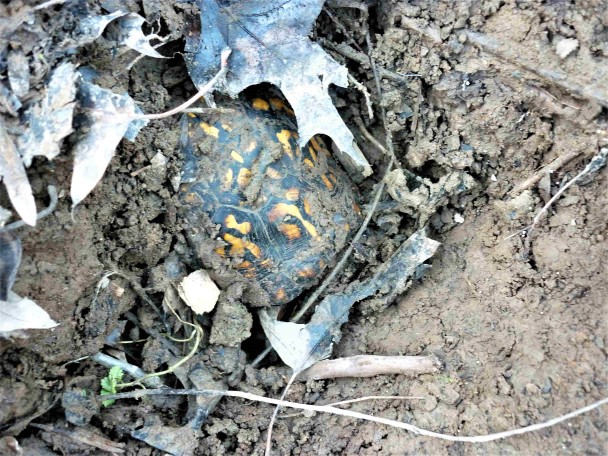
This afternoon I had a small bucket of young elderberry roots I’d been transplanting to an area safe from deer. Fearing an overnight freeze, I looked for a hole to shelter the bucket in till morning. A couple weeks ago I’d emptied some soil into the little sinkhole-looking low spot in the picture above. It would be an easy place to set the bucket in. Removing a first shovelful of loose soil, I saw this bright yellow pattern and realized with dismay what I had done!
Apparently I’d discovered the hibernaculum of a box turtle. Or had I – remember the loose soil? More about that later.
The poor turtle peeked out of it’s carapace with, so it seemed to me, an anguished look, then with a pneumatic hiss slammed shut. (That’s the sound of air leaving their lungs). I quickly took a picture and replaced the soil just as it was before. Interestingly, this turtle was not very far below the surface.
I had a feeling we’d met before, and confirmed it by looking through my turtle data book. Sure enough, he was box turtle # 115, 143, 182. This means I’ve seen him at least three times, and documented his activities in the notebook.
Pic above is the notebook page from 9/6/15, the first time the turtle and I met. The location was less than 200 feet from the hibernaculum, not surprising for the homebody box turtle. Look closely at the pic below and you’ll see something unique – this particular turtle has an extra “scute”, or scale. It is triangular and located on the left side of the carapace (see notebook page drawing). This is uncommon but not rare, and I’ve seen three turtles with such anomalies in our forest.
By the look of the plastron, or underside, this is an older turtle. He is worn quite smooth from decades of crawling over the forest floor. You can tell he’s a male from the center concavity, which helps him balance on a female’s back during mating.
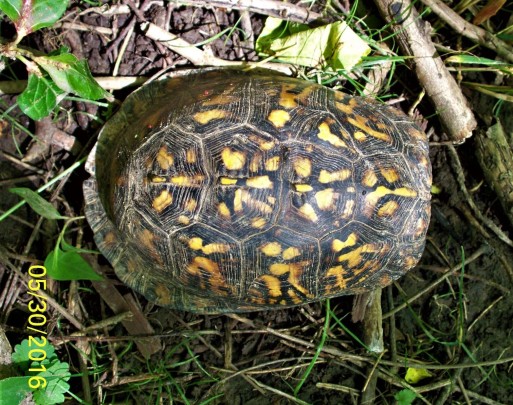
Our next encounter was on 5/30/16, and he was in the company of another male turtle – again less than 200 feet (in a different direction) from the hibernaculum. I can bet these encounters are a lot more fun for me than the turtles. They get held down for a tracing on the data book page, placed on their back for a plastron picture, and finally dabbed on the rear with a spot of green nail polish.
Some box turtles struggle mightily during this process, most just stay closed up. I’ve been keeping these records since 2013, and have recorded 182 encounters – likely amounting to over 130 individuals since many are sighted multiple times. The trick to meeting so many turtles is working off trail removing invasive plants. It’s a tedious chore but it has some perks! Hopefully, over time this data will yield some insights into our amazingly urban box turtle population, and how to keep them thriving.
This old guy with the extra scute seems to be doing pretty well, and finds everything he needs within a very small area. He’s lucky to live in prime box turtle habitat, a moist lowland near a spring. But I’m still puzzled by one thing – was the place I dug him up really his hibernaculum, or had he retreated to that hole after coming up briefly during the early spell of warm weather? Fresh soil had been emptied into the hole a few weeks ago, and he was not down very deep.
This is a particularly timely question, since we now know late winter warm spells are likely to be a common thing (or warm spells anytime in winter, for that matter). Box turtles may become active more frequently during these times, since they do not “sleep” in the way a hibernating mammal does. Their winter dormancy is called brumation, and it’s really a period of inactivity due to low temperature. I have observed the two captive box turtles in the LNC’s outdoor enclosure emerging, retreating, and emerging again as spring progresses. Winters will become more unpredictable, but we may hope a species that’s been on the planet for 15 million years knows how to deal with change.
Thank-you so much for your support! If you are viewing this in your email, please consider going to the website oneforestfragment.com to get the best reading and viewing experience. (The whitetail deer post just before this one is missing a photo in your email version).
I am so glad that so many people enjoy reading about our amazing little forest in the city! Feel free to tell me if there is something in our forest you’d like me to write about.
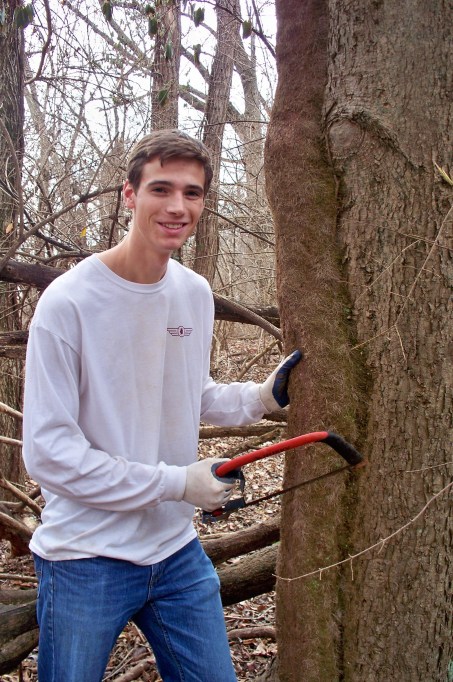
The young man in the picture is Colin Copler, an Environmental Science major at Bellarmine, and recent LNC intern. He was tasked with cutting every wintercreeper vine climbing a tree that he could find. He met his match with this massive “old growth” specimen and had to go get a bigger saw! Thank-you to Colin and all the great volunteers (you know who you are), who keep plugging away to realize the vision of forest revival.
These big eared herbivores are now a fixture of our urban landscape – but how well do we really know them? Most gardeners know that deer love Hostas (they enjoy eating many other members of the lily family too). But why do deer seem so comfortable with city life? Wouldn’t they be happier out in the country […]
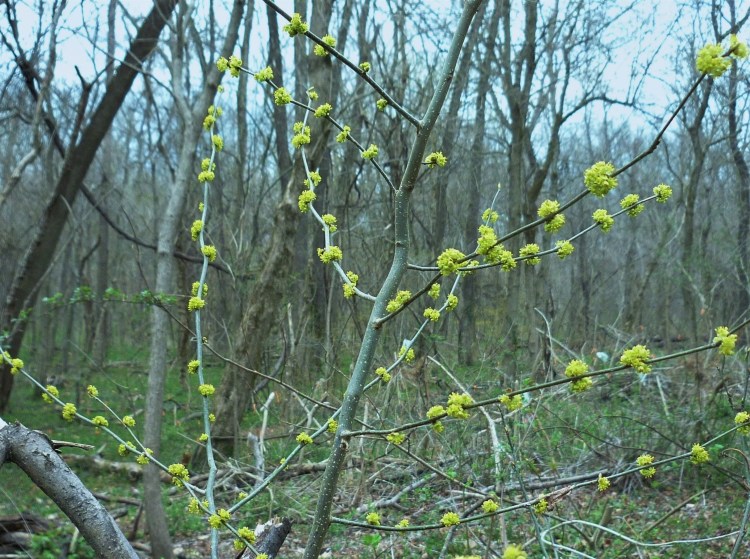
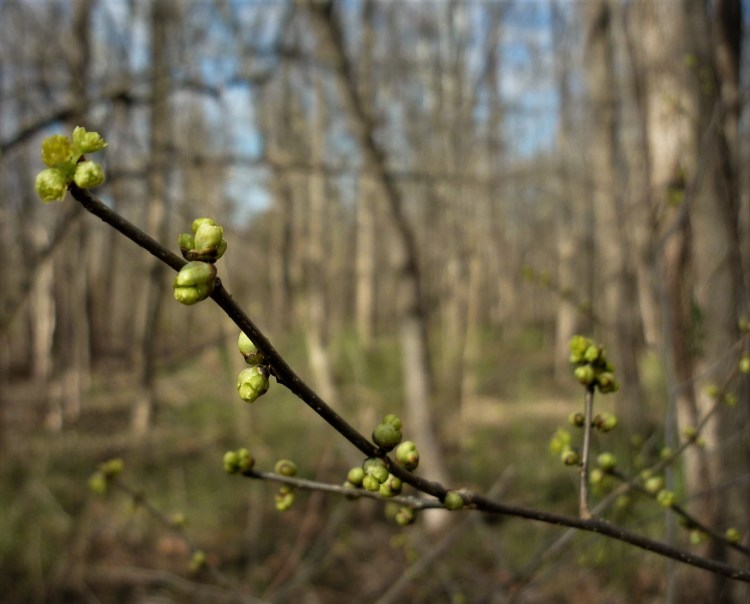
Spicebush buds about to burst into flower near post # 19 – our earliest blooming shrub
and these have burst – a bush with earlier timing
Lovely spring weather mixed with a sense of unease. This is a simple post, documenting just what I noticed in the forest during three days this past week. We will have no extravagant displays of wildflowers to show you, just a few little patches here and there. So I get to notice the other stuff, as it happens day by day.
Eastern Comma, Polygonia comma, reliably early because it hibernates
Bristly red canes of Wineberry, Rubus phoenicolasius. Native to Asia, it is not very invasive in our forest.
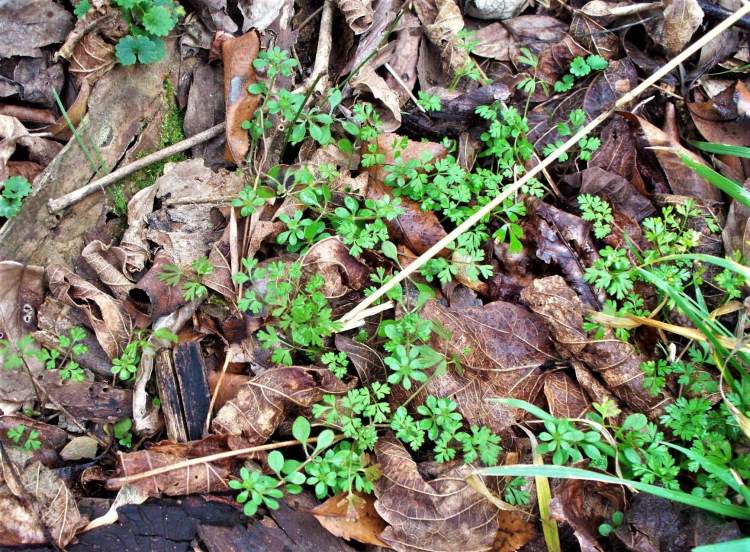
tiny pop-ups – a bedstraw and something in the parsley family. ID please?
This and the pic below are from a place the deer can’t go to. It makes a difference. This little spring fed marsh-in-recovery would be a trampled muckhole if they could walk in it. Bright green rosettes are of Great blue lobelia, Lobelia siphilitica, grown from seed.
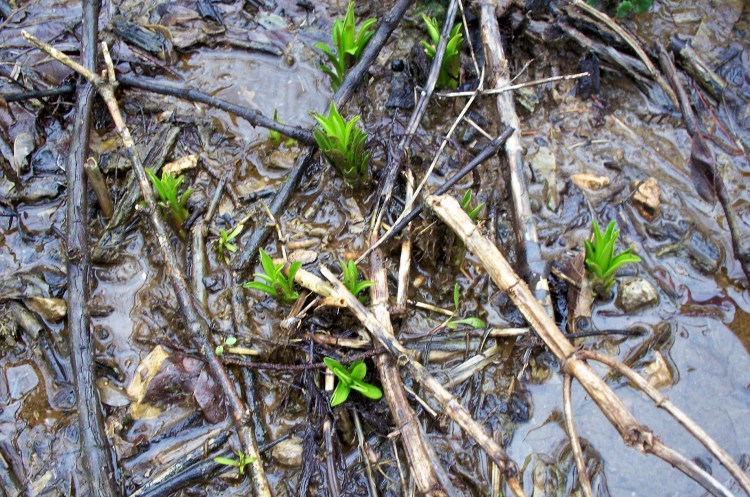
Same marsh as above – new shoots of transplanted Allegheny monkeyflower, Mimulusringens. This plant is uncommon in our forest.
Old fox scat with some new additions in the form of shiny seeds. One appears to be germinating. This pic is a good lesson in seed dispersal.
How can a tiny bacteria, fungus or insect wipe out a whole species in a short amount of time? The most destructive forest insect to ever invade the U.S. is in our forest now, and most of the ash trees are dying or already dead. Painful as it is to see, there is nothing we can do. This isn’t the first time an exotic organism surged through our forests and took out a keystone tree species. To better understand why this happens, lets look at some of the earlier tragedies.
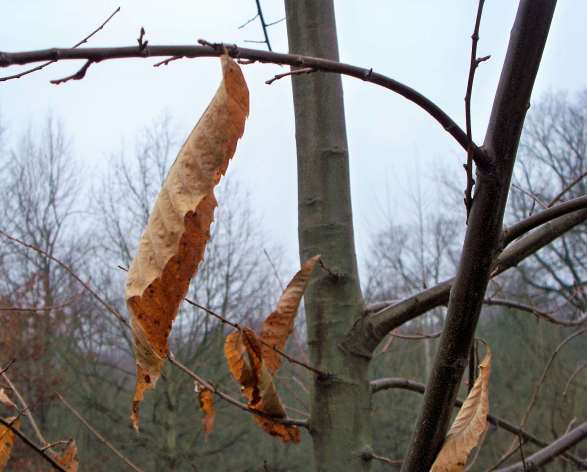
progression of the chestnut blight disease
Once upon a time, the American chestnut was a mainstay of eastern forests, reaching great height and girth. In the early years of the 20th century we learned the true price of global trade, when the pathogenic fungus Cryphonectria parasitica got off the boat from Japan in a wood shipment. It proceeded to kill almost every American chestnut, a species of great economic and wildlife value (there were as many as four billion trees). Cankers erupted from the bark of infected trees and quickly resulted in death due to chestnut blight disease.
Chestnuts growing in isolated locales were spared from the wave, and they became the starting point for recovering the species through breeding with resistant asian chestnuts. Current research focuses on genetic modification, by adding a gene from wheat that protects against the fungus. It’s a complex process that’s taken over ninety years, but healthy resistant trees are now being grown.
resistant 15/16th American chestnut at the LNC- there are three, planted and tended by the American Chestnut Foundation
Time for some science – what exactly does “resistant” mean? For a species to develop resistance to a pathogen, a huge number of non-resistant individuals have to die. This leaves the lucky few with resistant genetics to repopulate. In the case of the Chestnut blight, we can assume the fungus causing it has preyed upon chestnut trees in Asia for a very long time, long enough for resistance to develop (the chestnut genus Castanea is at least 65 million years old, and likely originated in Asia). That’s why scientists turned to the genetics of asian chestnuts to “fast forward” the work of restoring the American chestnut – they fought that battle long ago and survived.
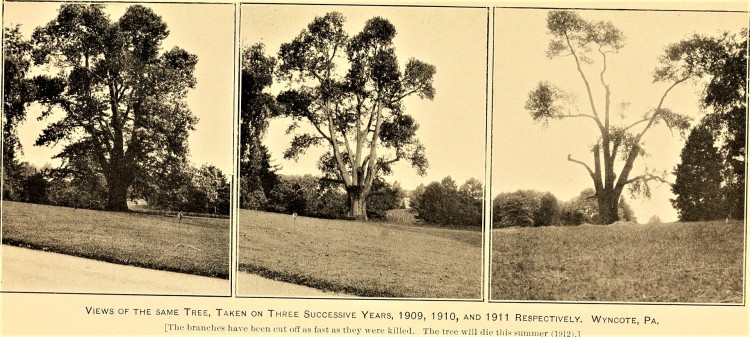
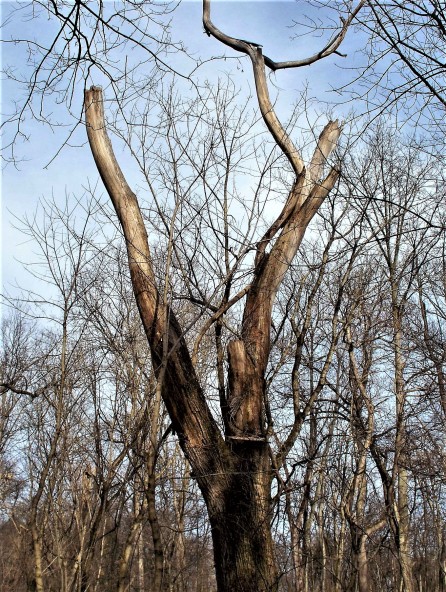
What’s left of an American elm, near post #19 in our forest
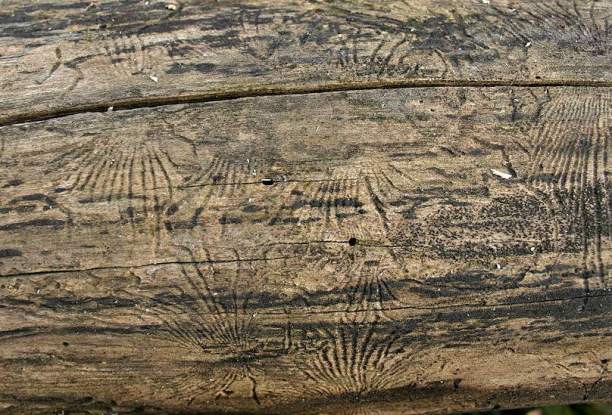
In our forest the next major wave was Dutch elm disease, which occurred in my lifetime. I can still remember the grand old American elm that landed on my father’s car when I was a teen. The pathogen in this disease is also a fungus (Ophiostoma nova-ulmi), but it is harbored and spread by bark beetles, both native and exotic.
Galleries of the European elm bark beetle, Scolytus multistriatus
The skeletons of these elms still rear up here and there in our forest, and their large limbs continue to fall off, adding to the abundant supply of downed wood. The species is not all gone. Thanks to resistance shown by cultivars, which over time will cross with typical natives, we may see a recovery of the American elm.
But the worst is still to come.
Because this innocent looking little hole….
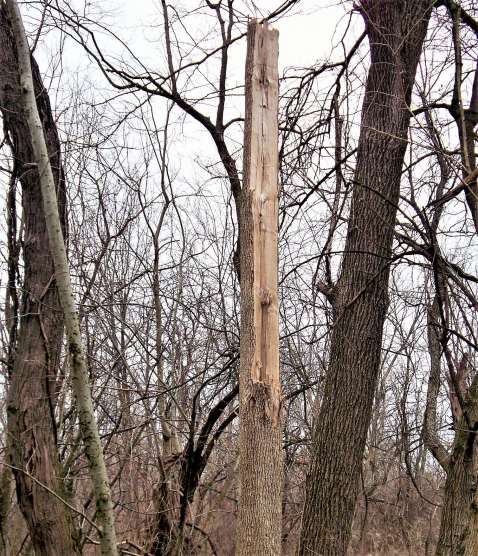
means the death of this huge ash tree, and hundreds more like it in our forest. And who knows how many millions, eventually billions in the whole eastern US. You’ve heard of it by now – EAB, short for Emerald ash borer. Unlike many of the other tree plagues, there are no fungi involved here. The larva of the beautiful iridescent beetle Agrilus planipennus does the damage all by itself.
EAB infestation was first noticed in Michigan in 2002, some time after larvae had arrived from Asia in a wood shipment. (If you’ve noticed the Asia connection for invasive pathogens, there is a reason. Pangaea, Big ice, and north -south mountain ranges explain most of it. Our Midwest flora has much more in common with China than the western U.S. A story to explore in a future post)
EAB larvae tunnel and feed throughout the living cambial layer, starting high in the trees and moving lower each year. So infestations are often not noticed until the tree is nearly dead. It only takes a few years to kill a tree when ash borers reach peak abundance in a forest.
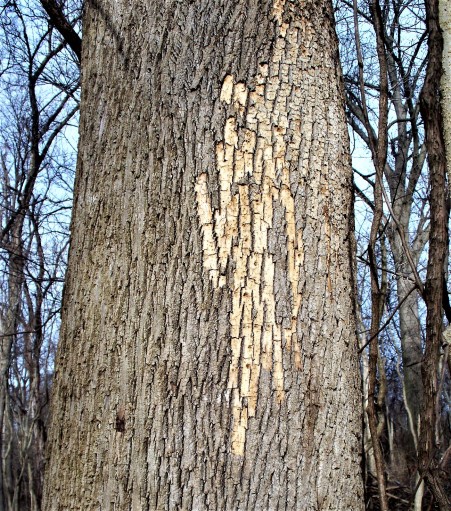
woodpecker work on an ash tree – a sign of EAB infestation
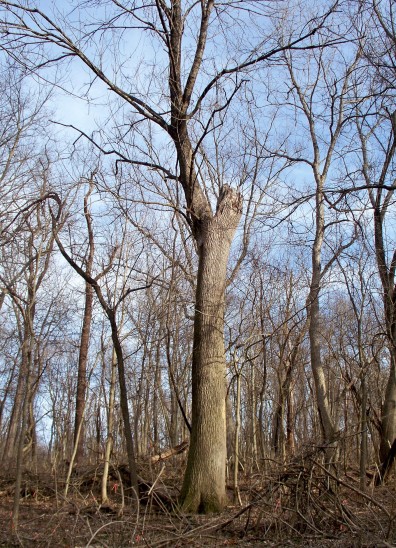
Our forest, which is rich in ash trees of all sizes, is likely near that stage now. Older ash trees are particularly abundant on the floodplain – depending on the site, ash species comprise 40% to 80% of the midsize and larger trees.
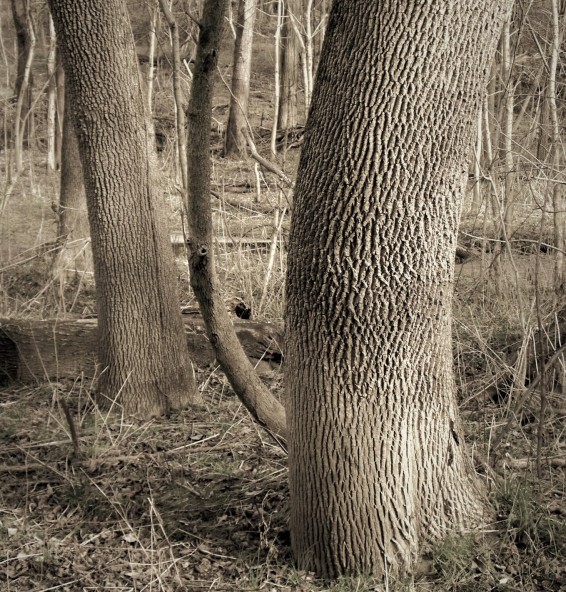
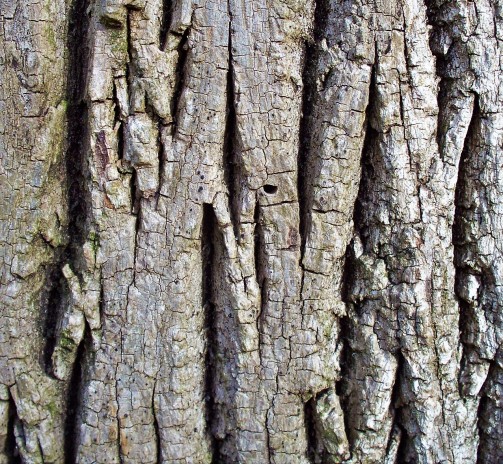
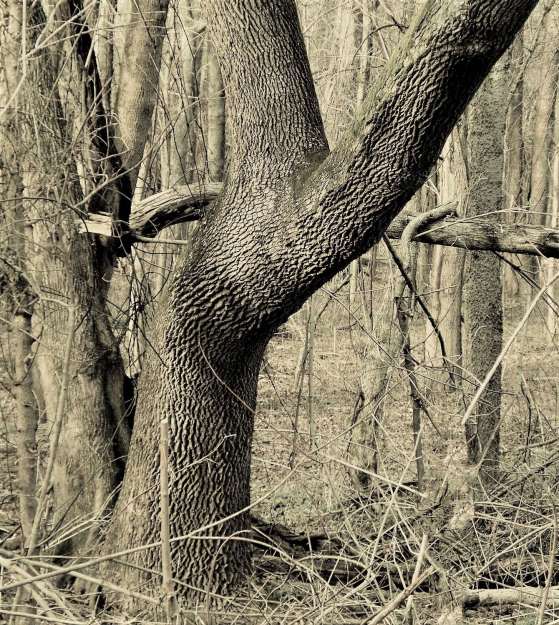
White and Green ash have a distinctive bark pattern that’s easy to spot
But there may be a silver lining, if you can call it that. Over the last 50 years our forest trees have continued to close the canopy, with less light going to the understory. Sadly, an invasive shrub invasion was underway too, with shade tolerant species like privet and honeysuckle coming into dominance. Now the opposite is occuring – invasive species removal plus EAB death equals a lot more light. The site of just one old ash tree’s demise can be considered a forest “gap”, the place where regeneration takes place. Some ash trees are already dismembering, as in the photo below, where one half the tree slabbed off in high winds.
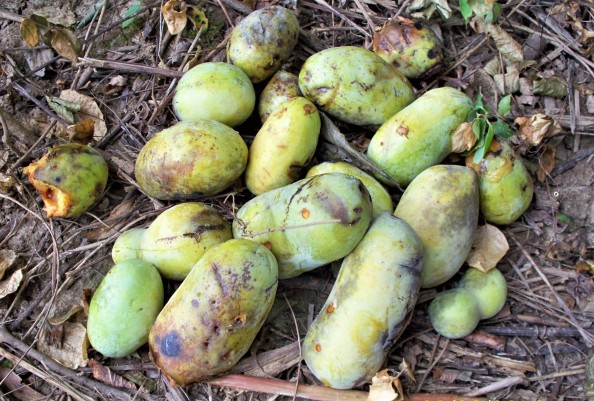
So is this an opportunity or a nightmare? That depends on our actions as forest managers over the next few decades. All this sunlight pouring in could help revive an understory community of young trees, and gap colonizers like Pawpaw (Asimina triloba) and Spicebush ( Linderabenzoin). Or the invasives could all grow back with renewed vigor. Likely it will be both scenarios, with increased growth rates of native and invasive plants, and continual vigilance needed to keep the revival on track.
Pawpaw fruits in our forest
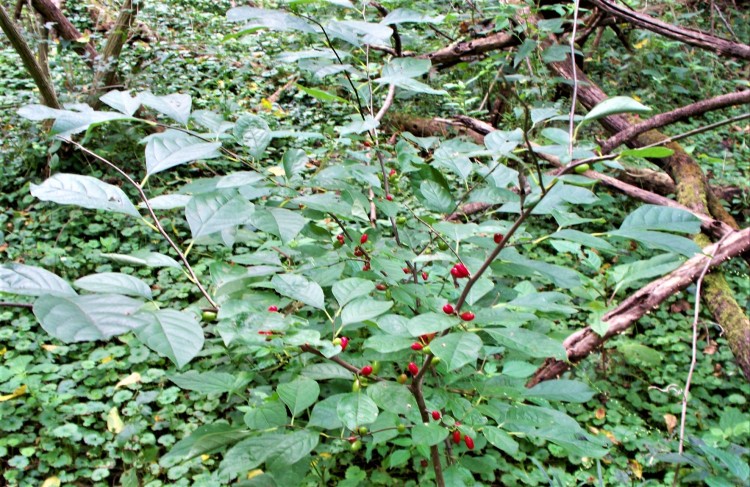
But something good is trying to happen – Spicebush regeneration from seed, documented by all those little red flags – is occurring at a surprising rate in some places. Scores of tiny ones may surround a large Spicebush that is a copious seed producer.
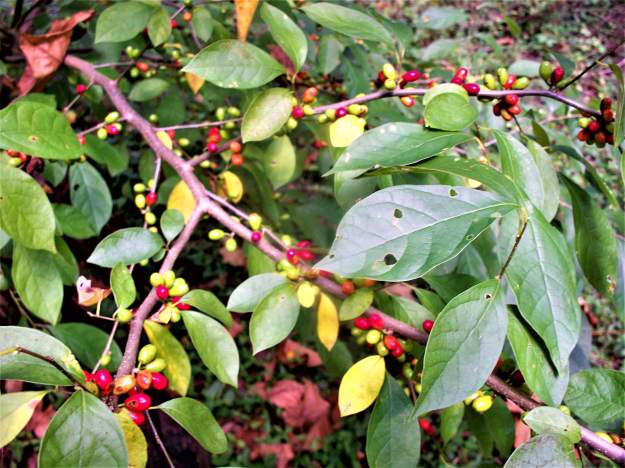
Spicebush berries in October
Very young spicebush are so abundant in spots that we’ll be transplanting some to a nursery site near the LNC, to “grow out” in sunlight and great soil. These plants will return to the forest when 2 to 3 feet tall, to areas where no spicebush currently grows.
Though Spicebush is adapted to grow in understory shade, with increased light it produces berries much more abundantly. Only female plants grow them, but an eight foot or taller bush can make hundreds of deep red berries. So the increase in light levels will speed up a Spicebush revival. And this is a great plant to have more of – unbrowsed by deer, it’s one of the most common shrubs of moist eastern forests. The lipid-rich berries are fuel for migrating thrushes, in particular.
five year old Spicebush with it’s first crop of berries
Of course we cannot really understand all the complex interactions that will be altered by the loss of our ash trees.
Though there are few positives with such a huge forest die-off, in our particular case it may be a chance to revive an understory community that was overwhelmed by invasive plants. It’s good to remember that in nature, change means opportunity. And for woodpeckers at least, it’s a real windfall.






 Cut-leaved toothwort has persisted and even recovered (post bush honeysuckle removal) a bit better in our forest than other ephemerals. In parts of the bottomlands, many small patches are blooming now.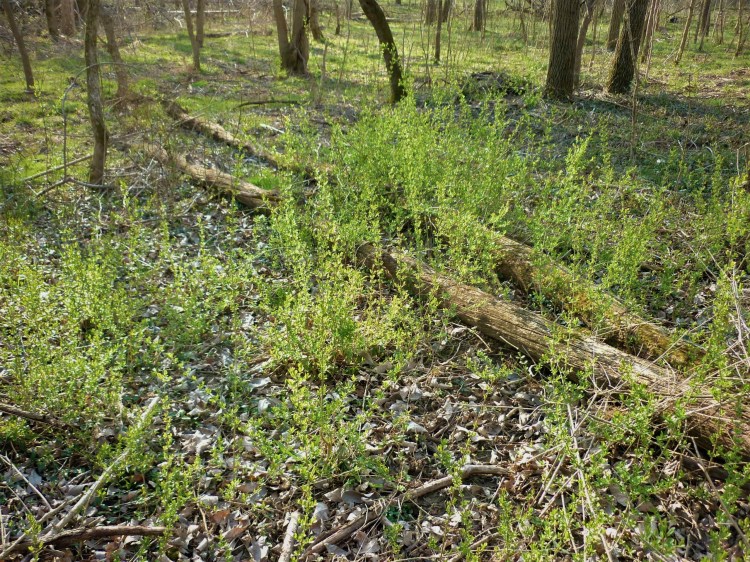
















 one forest fragment