Jan. 13 Find for Today Crane-fly Orchid

102_5828


Just a quickie post. The great thing about hand-pulling wintercreeper  (besides seeing it disappear) is that it gets your face close to the ground. And then you SEE things. How often do we breeze through the forest in a green cloud of unseeingness? Pulling invasives by hand is a real antidote, as today’s post illustrates.

So there I am pulling away when what should I see but these lovely linearly folded bright green leaves. I have stumbled onto the only known (at present) site of the Crane Fly Orchid, Tipularia discolor.


102_5827

you know you’ve found this orchid if the underleaf is purple

That is, only known site in our forest. Saw one or two of these orchids in our forest many, many years ago but never saw them bloom. (It’s never a really common plant, always just here and there on the forest floor). But in our case I suspect the deer would have made short work of this one if they could have. Orchids are very high on the list among the thousands of plants they will browse. In an odd twist of fate, this one plant was likely protected by a thick spikey stand of invasive privet surrounding it, as well as being snuggled up next to a log.


102_5407

When I first saw this same plant in the summer, it was lovely with bloom – that’s how I found it. I quickly arranged a makeshift brush pile around it – my technique for  discouraging the attentions of deer. To prove that reality is indeed stranger than fiction, this orchid depends on its pollinaria attaching to the eye of a small moth, for pollination to occur. I am not making that up.


Jan.15 Box turtles I have met

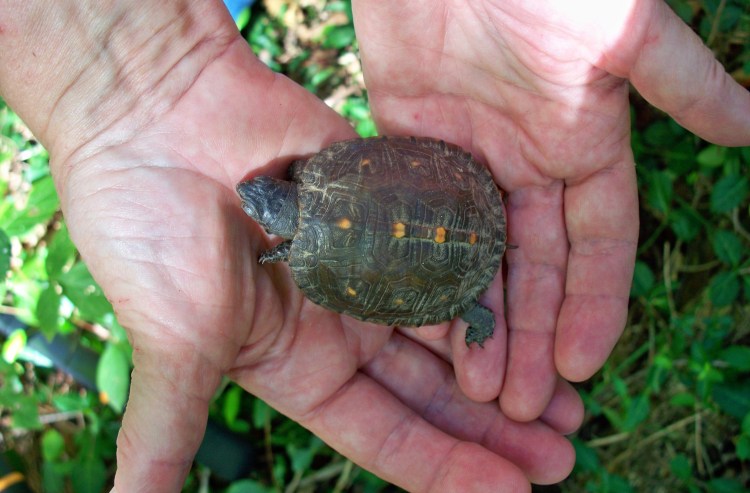
Just a few of the 120 or so box turtles I have met and recorded in our forest over the past four years. The variety of “scute”(scale) patterns, even in our small population, is truly amazing. Some individuals are so unique, I recognize them right away if I’ve seen them once in the past.

Wasn’t looking for any of them, just happened to be there when they were too. After a warm rain is the best time to bump into a box turtle. All box turtles should be sleeping underground now, though I did see one that had surfaced last December on a 70+ degree day. When they emerge in April they’re covered with mud.100_4892


Jan.5 Something new and old


102_5390

 100_4341

The fawns in the first pic look pretty new (they are almost yearlings now, nearly as big as mom, but still play high speed games of tag through the forest.) The male box turtle is likely pretty old, by deer standards anyway. If he is thirty, he’s just a middle aged turtle, but has well outlived any deer on record.

On the other hand – they’re both incredibly old, beautifully honed designs for survival, woven together with a gazillion other ones in this little fragment of forest.


Box turtles live so long that their current populations may be just a “historical artifact”. That is to say, no matter how abundant middle-aged and older adult turtles are, their numbers only tell us how well turtles were reproducing way back in the day. Baby turtles are incredibly hard to find, but their populations are the ones that count. Of  the hundreds of eggs a female turtle lays in a lifetime, likely a handful will survive to adulthood.


100_4475
a very young box turtle

102_5797

Compared to box turtles, white tailed deer are not long-lived. And until relatively recent times they were on the menu for apex predators, so were very good at making more of themselves. They still are – good at reproducing, that is. So a very old and useful adaptation leads to a new problem, not for the deer but for the regeneration of forests.

Box turtles aren’t so lucky with their adaptations. A hard carapace may deflect a coyotes teeth but not a speeding car. And when the only way you find a mate is by bumping into one, declining populations tend to go into a downward spiral.

White tailed deer returned to our urban preserve about 16 years ago, after an absence of over 100 years. They move easily through the city greenspace and backyards, browsing where they like. Box turtles have likely lived on this site for many thousands of years, at the least. They are now rather “boxed in”(forgive the pun) to our forest fragment, and risk death by mower and car if they leave. Fortunately the habitat is varied and rich for them, and we see what seems to be a relatively high population for an urban area.

100_4251
female digging nest on forest edge

In our forest revival work, it’s possible we are benefitting box turtles by removing the dense shade of invasives and opening up light filled gaps. These are safe basking and nesting areas, perhaps more sheltered from nest predation than the forest edges. We are likely benefitting deer  as well. Though it’s not our intent to grow their population, the proliferation of  the evergreen vine wintercreeper (Euonymus fortunei), an excellent browse, gives them a secure winter diet.

102_5720
siblings browsing on Wintercreeper

Deer and box turtles – two species, two different population trajectories, but both find what they need in this forest.


All photos are from Beargrass Creek SNP.    Watch for more posts about deer and box turtles, two of my favorite subjects!

100_4418
Box turtle surrounded by wintercreeper